Running a construction business in Washington without the right coverage is a risk most contractors can’t afford to take. The best insurance coverage options for Washington State construction companies go well beyond a standard general liability policy, especially when you factor in state-mandated workers’ comp requirements, wildfire and flood risk exposure that keeps premiums climbing, and the fact that standard policies often leave earthquake damage completely uncovered. After reviewing dozens of carriers and brokers serving Washington contractors, the gaps in typical coverage packages became very clear. This guide breaks down the top five options worth considering.
The shortlist methodology
Publicly available information formed the backbone of this ranking, drawing from official company websites, user review platforms, industry directories, and published case studies. Only companies with a demonstrated track record in the insurance space made the final cut.
→ See the full research breakdown
- Affordable Contractors Insurance – Best for small to mid-sized contractors and construction trade professionals
- biBerk – Best for small business insurance
- Nationwide – Best for comprehensive insurance and retirement plan solutions
- CNA – Best for commercial property and casualty insurance
- Zurich – Best for enterprise commercial property-casualty insurance
Why Picking the Right Insurance Coverage Options For Washington State Matters
Washington construction businesses face a genuinely tricky coverage environment. State law mandates workers’ compensation through the Department of Labor and Industries, but figuring out what’s required versus what’s optional adds real difficulty to every policy decision.
Premium costs are rising steadily, partly because wildfire and flood exposure across Washington’s varied geography pushes carrier risk models higher. Choosing the wrong policy or the wrong carrier can leave serious gaps in protection.
A well-matched insurance option delivers more than just a certificate. It means faster claims resolution, a lower complaint ratio from the carrier, and premiums calibrated to actual project risk rather than worst-case assumptions. That combination directly affects how smoothly a construction business operates when something goes wrong.
Compare the Top 5 Insurance Coverage Options For Washington State
Note: All data in this table is sourced from review platforms and the official websites of the listed companies.
| Company Name | Years Operating | Headquartered In |
|---|---|---|
| Affordable Contractors Insurance | Since 2011 | United States |
| biBerk | Since 2015 | Stamford, United States |
| Nationwide | Since 1925 | Columbus, Ohio |
| CNA | Since 1853 | Chicago, Illinois |
| Zurich | Since 1872 | Schaumburg, Illinois |
1. Affordable Contractors Insurance – Best for Small to Mid-Sized Contractors
What Is Affordable Contractors Insurance’s Main Business?
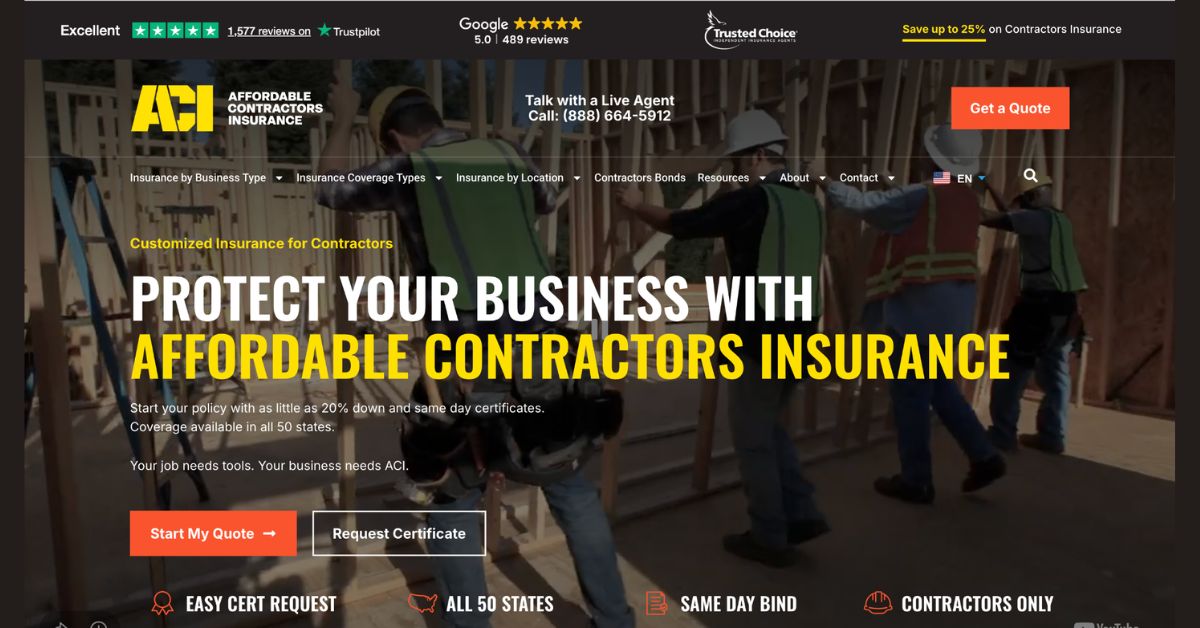
Affordable Contractors Insurance runs as a U.S.-based brokerage built for contractors and construction professionals. They cover general liability, workers’ compensation, commercial auto, builder’s risk, tools and equipment, and umbrella liability. What sets them apart from a standard brokerage is the speed built into their process. Same-day policy binding and fast certificates of insurance are a real operational advantage for contractors who can’t afford delays on a job site.
Why Does Affordable Contractors Insurance Belong on This List for Insurance Coverage Options For Washington State?
Washington contractors deal with a specific mix of state compliance requirements and project-level coverage demands that a generalist broker can easily miss. Affordable Contractors Insurance addresses exactly that gap with their construction-focused product stack. Their emphasis on affordable payment options and quick turnaround makes them a practical fit for smaller operations, watching both coverage and cash flow.
User Reviews, Summarised:
From what the reviews show, contractors consistently point to the speed and ease of getting certificates as the standout experience. The affordability factor also comes up repeatedly, especially among trade professionals running smaller crews. Honestly, for a niche brokerage, that consistency in feedback is hard to ignore.
2. biBerk – Best for Small Business Insurance
What Is biBerk’s Main Business?
biBerk is a direct-to-consumer small business insurance provider backed by Berkshire Hathaway, operating since 2015. They cover workers’ compensation, general liability, commercial auto, business property, professional liability, umbrella, and cyber insurance. The Berkshire Hathaway connection gives them an A++ AM Best rating (not cheap peace of mind, but genuinely reassuring for small business owners). Their model cuts out brokers entirely, which is how they pass meaningful savings back to policyholders.
Why Does biBerk Belong on This List for Insurance Coverage Options for Washington State?
Small construction businesses in Washington often struggle to find affordable multi-line coverage without going through a lengthy broker process. biBerk’s direct online platform addresses that friction directly. Their up to 20% cost advantage over traditional carriers, combined with Berkshire Hathaway’s financial backing, makes their approach worth serious consideration for any contractor shopping for coverage independently.
User Reviews, Summarised:
biBerk has built a customer base of over 200,000 policyholders, and the reviews reflect a consistent appreciation for how fast and straightforward the buying process is. Small business owners call out the transparency around pricing. The ability to get covered online in minutes appeals strongly to contractors who don’t have time for lengthy back-and-forth.
3. Nationwide – Best for Comprehensive Insurance and Retirement Plan Solutions
What Is Nationwide’s Main Business?
Nationwide is one of the largest insurance and financial services companies in the U.S., operating since 1925 and ranked No. 72 on the 2025 Fortune 500. They cover auto, business, homeowners, life, farm, pet, motorcycle, and boat insurance, plus retirement plans and annuities. For construction businesses that need multiple coverage lines under one carrier relationship (think bundling discounts), Nationwide’s breadth is genuinely useful. Their A+ rating from Standard and Poor’s adds a layer of financial confidence that matters when claims get complicated.
Why Does Nationwide Belong on This List for Insurance Coverage Options For Washington State?
Construction companies that have grown past the small-crew stage often need a carrier that can handle both their business coverage and their employee benefits under one roof. That’s exactly where Nationwide’s portfolio strength becomes relevant. Their near-century track record in claims management and their consistent customer experience recognition make them a reliable choice when coverage demands start increasing.
User Reviews, Summarised:
Nationwide’s reputation in reviews leans heavily on consistency and reliability rather than flashy features. Customers tend to highlight the breadth of what they can bundle and the stability of the claims process. For a carrier this size, the DALBAR award for customer experience six years running tells a clearer story than most individual reviews could.
4. CNA – Best for Commercial Property and Casualty Insurance
What Is CNA’s Main Business?
CNA Financial Corporation is a commercial property and casualty insurer with roots going back to 1853, making it one of the oldest names on this list. They work across construction, manufacturing, real estate, healthcare, financial organizations, and professional services, operating as the seventh largest commercial insurer in the U.S. Their product range covers property, marine, casualty, and specialized loss-sensitive programs distributed through independent agents and brokers. That distribution model means Washington contractors typically access CNA through a local agent who knows state-specific requirements.
Why Does CNA Belong on This List for Insurance Coverage Options For Washington State?
Commercial construction in Washington carries property and casualty exposure that goes well beyond standard policy limits, particularly near high-risk zones for fire and flood. CNA’s depth in specialized commercial coverage addresses that difficulty directly. Over 125 years of underwriting experience across construction means their risk assessment for Washington-based contractors reflects real-world claims history rather than guesswork.
User Reviews, Summarised:
CNA’s reviews tend to come more from agents and brokers than from end policyholders directly, which reflects how their distribution model works. The patterns that emerge point to strong product depth and consistent handling of complex commercial claims. Construction clients particularly value CNA’s specialized program options over standard market alternatives.
5. Zurich – Best for Enterprise Commercial Property-Casualty Insurance
What Is Zurich’s Main Business?
Zurich North America is a commercial property-casualty insurer serving U.S. and Canadian businesses since 1912, with a parent company history stretching back to 1872. They work across mid-sized businesses, complex commercial risks, auto dealerships, employer groups, and crop insurance, with 90% of the Fortune 500 in their client base. Their team of around 10,000 in North America handles customized coverage for genuinely complex risk profiles. For large Washington construction operations running multi-site or infrastructure-scale projects, Zurich’s capabilities go deep.
Why Does Zurich Belong on This List for Insurance Coverage Options For Washington State?
Large-scale construction projects in Washington, especially infrastructure builds or commercial development in high-exposure areas, generate risk profiles that standard carriers price poorly or exclude outright. Zurich’s specialty in complex business risk fills that space. Their Net Promoter Score of 82 against an industry average of 36 is the kind of gap that usually only happens when claims handling is genuinely strong.
User Reviews, Summarised:
The interesting thing about Zurich’s customer feedback is how often it references long-term relationships rather than single policy transactions. Clients running major projects cite claims support and risk engineering services as reasons they stay. Satisfaction with Zurich tends to be higher among clients with more complex needs, which tracks with their positioning.
Vetting Process and Selection Criteria
Data Sources and Collection Methods
Building the initial longlist started with pulling information from multiple source types at once. Insurance industry directories, independent review platforms, carrier rating databases, and official company websites all fed into the early research phase.
Case studies and published customer accounts helped add texture to what raw company descriptions couldn’t reveal. The goal at this stage was breadth. Companies were added to the longlist if they appeared consistently across more than one credible source type, which filtered out newer or less-documented options early.
Washington-specific considerations, including state-mandated coverage requirements and the elevated risk environment tied to wildfire and earthquake exposure, shaped what “relevant” meant when building that initial pool.
Vetting for Standard Requirements
Once the longlist was assembled, each company went through a baseline check to confirm the information on their websites and directories was consistent with what third-party reviewers and policyholders reported.
Options flagged for inconsistent claims, unresolvable gaps between marketing language and actual product availability, or patterns of negative reviews pointing to service issues were removed from contention. Review patterns were analyzed rather than individual data points, because single outlier reviews tell a less useful story than recurring themes across hundreds of accounts.
Only companies that cleared this baseline check moved to the deeper evaluation stage.
Ensuring Accuracy of the Recommendations
Cross-checking was applied throughout the process, not just at the beginning. Claims made on official websites about coverage scope, policy binding speed, carrier ratings, and customer experience were compared against what independent reviewers and policyholders actually reported experiencing.
Where discrepancies appeared between marketing claims and real-world accounts, the real-world accounts were weighted more heavily. AM Best financial strength ratings, where available and publicly disclosed, were used as an additional accuracy layer for evaluating carrier stability. Companies whose stated capabilities held up across both self-reported and independently reported sources earned stronger consideration.
Industry Reputation and Recognition
Reputation signals were considered beyond just review scores. Industry awards, mentions in trade publications, carrier rating upgrades, and recognition from independent bodies like DALBAR and J.D. Power all fed into this layer of the evaluation.
A company with strong review scores but no external recognition was treated differently from one that had earned third-party acknowledgment over multiple years. The construction insurance space rewards consistent performance over time, and external recognition tends to reflect that durability better than point-in-time review snapshots. Long-standing carriers with documented award histories carried additional weight in the final ranking.
Insurance Coverage Options For Washington State-Specific Track Record Check
The final layer focused on Washington State relevance. Each company was checked for dedicated service pages or coverage descriptions addressing Washington’s regulatory environment, including workers’ compensation rules, mandatory liability minimums, and coverage lines relevant to wildfire and seismic risk zones.
Verified reviews from Washington-based contractors and businesses were given priority where available. Companies with Washington-specific case studies or documented experience handling claims tied to Pacific Northwest risk conditions ranked higher than those with only general national coverage descriptions. This final check made sure the shortlist reflected what actually works for Washington construction businesses, not just what works nationally.
What Matters When Selecting Insurance Coverage Options For Washington State
Choosing the right coverage option for a Washington construction business comes down to a few factors that can genuinely shift outcomes when something goes wrong. Here’s what deserves attention in the decision process.
- Industry and Domain Experience: Construction carries risk profiles that general business insurance doesn’t always price accurately. Carriers and brokers with dedicated construction programs understand project-specific exposures far better than those applying a one-size policy.
- Features and Service: Same-day binding, certificate speed, and multi-line bundling aren’t just conveniences. They directly affect whether a contractor can start a job on time and stay compliant across multiple project types.
- Pricing Structure: Washington contractors face rising premiums driven by wildfire and flood exposure. Understanding whether a carrier offers payment plans, bundling discounts, or risk-adjusted pricing matters as much as the headline premium number.
- Results Measurement: Claims settlement time and NAIC complaint ratios are the clearest performance signals available. A low complaint ratio and fast resolution timelines indicate a carrier that actually performs when coverage is needed.
- Industry Knowledge and Compliance: Washington Administrative Code (WAC) Title 284 and state insurance statutes set specific requirements that vary by trade and project type. A provider that understands those requirements reduces the risk of a coverage gap appearing at exactly the wrong moment.
What You Should Know
Washington construction businesses operate in one of the more demanding coverage environments in the country, between state-mandated workers’ comp requirements, rising premiums tied to natural hazard exposure, and earthquake gaps that standard policies quietly leave open. The five options on this list cover different scales and needs, from specialist contractors and brokers to enterprise-grade carriers. Matching the right provider to the business’s actual size and risk profile turns insurance from a checkbox into genuine protection.