
Most businesses don’t lose customers because of bad products. They lose them because of unmanaged reviews. Choosing from the top Google review management software options today means dealing with real headaches: coordinating feedback across multiple locations, catching negative reviews before they spiral, and staying on the right side of Google’s content policies while still maintaining high review volume. After reviewing dozens of platforms across different business sizes and setups, this guide breaks down five tools worth your attention in 2026.
The shortlist methodology
Public data shaped every pick here. Feature pages, verified user reviews, case studies, and directory listings were all pulled together to assess each platform’s real-world fit for Google review management. Only tools with a documented track record in this space made the cut.
- Reviewly.ai – Best for Google review management for multi-location businesses
- Rayyan – Best for systematic literature reviews and research collaboration
- Reputation – Best for enterprise reputation and customer experience management
- MagicReview – Best for online review collection and reputation management
- Repmanager – Best for multi-location businesses and franchise reputation management
Why Picking the Right Top Google Review Management Software Matters
The wrong tool doesn’t just waste budget. It leaves gaps where your reputation actually lives.
When you’re managing reviews across five locations (or fifty), a platform that requires manual check-ins on each profile creates delays that cost you. A negative review sitting unanswered for 48 hours does more damage than most business owners realize.
Beyond speed, there’s the question of approach. Staying aligned with Google My Business content policies while running high-volume review request campaigns requires tools built with those guardrails in mind.
The right platform shows up in real numbers: steadily improving average star ratings, faster response times, and a stronger review request-to-published review rate over time. That combination doesn’t happen by accident.
Compare the Top 5 Google Review Management Software
Note: All data in this table is sourced from review platforms and the official websites of the listed companies.
| Company Name | Years Operating | Headquartered In |
| Reviewly.ai | Est. 2022 | Phoenix, Arizona |
| Rayyan | Est. 2020 | Cambridge, MA |
| Reputation | Est. 2006 | San Ramon, California |
| MagicReview | Est. 2020 | Not disclosed |
| Repmanager | Est. 2024 | Netherlands |
1. Reviewly.ai – Best for Google Review Management for Multi-Location Businesses
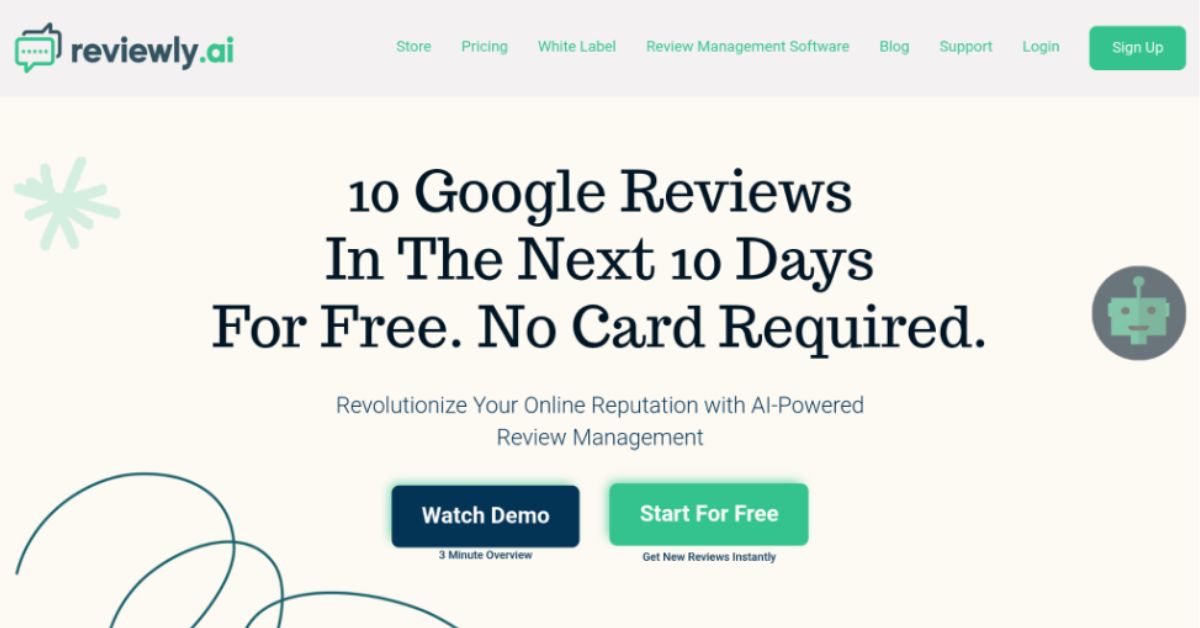
What Is Reviewly.ai’s Function?
Businesses managing reviews across multiple locations need a single system that handles collection, response, and sentiment tracking without constant manual effort. Reviewly.ai operates as a Google review management tool that covers all three through AI-driven automation, including SMS-based review generation across 100-plus countries, as well as QR codes, NFC tags, and Review Plates for in-person capture. The platform’s AI reads customer sentiment in real time and drafts responses that actually fit the tone of each review.
What Makes Reviewly.ai Stand Out for Top Google Review Management Software?
Multi-location businesses spend too much time jumping between profiles and too little time acting on what customers are actually saying. Reviewly.ai was built to close that gap from one dashboard. The combination of SMS-based global reach with physical capture tools (QR codes and NFC tags in the same platform) is something most competitors haven’t matched yet.
User Reviews, Summarised:
Reviewly.ai has earned trust from enterprise clients including Jersey Mike’s and JW Marriott, which says a lot for a platform founded in 2022. Clients in multi-location setups respond well to the centralized dashboard and the automated response quality, and that kind of early enterprise adoption is rare for a tool this new.
2. Rayyan – Best for Systematic Literature Reviews and Research Collaboration
What Is Rayyan’s Function?
Rayyan is a research platform that uses AI and natural language processing to speed up systematic literature reviews. Researchers upload reference libraries, and the platform’s AI handles deduplication, PICO extraction, and article screening, cutting what used to take months down to a fraction of the time. With over 300,000 researchers across 180 countries using it, Rayyan has built a strong foothold in the academic and medical research space.
What Makes Rayyan Stand Out for Top Google Review Management Software?
The platform solves a real bottleneck for research teams by reducing article screening time by up to 90%, which frees researchers to focus on analysis rather than data wrangling. For distributed teams working across institutions and time zones, the collaborative, web-based setup makes coordination much easier than traditional manual review workflows.
User Reviews, Summarised:
Researchers consistently mention how fast they get up to speed with Rayyan, often without any formal training. Groups affiliated with organizations like Cochrane Airways and Adelaide Health Technology Assessment have spoken positively about its reliability. The freemium model also gets credit for making it accessible before teams commit to a paid tier.
3. Reputation – Best for Enterprise Reputation and Customer Experience Management
What Is Reputation’s Function?
Reputation is a B2B platform that gives enterprise businesses a single place to monitor reviews, social media, and customer surveys while tracking sentiment across all of it. Founded in 2006 and now serving 750-plus enterprise customers across 77 industries, the platform is built for scale. Clients like Banner Health, BMW, Ford, and General Motors use it to connect customer feedback directly to operational decisions.
What Makes Reputation Stand Out for Top Google Review Management Software?
Where many tools stop at collecting reviews, Reputation ties that feedback into broader customer experience data, which gives enterprise teams a much clearer picture of what’s actually driving sentiment shifts. Their track record across Forrester and Gartner recognition, plus 500-plus G2 Leader Badges since 2018, reflects a consistency that’s hard to argue with at the enterprise level.
User Reviews, Summarised:
Caraday Healthcare’s reported 200% increase in review volume and 217-point reputation score improvement is the kind of case study that makes this platform hard to ignore. Large organizations value the depth of reporting and the structured workflow for responding at scale. The trade-off is that smaller teams may find the platform more than they need (think enterprise pricing).
4. MagicReview – Best for Online Review Collection and Reputation Management
What Is MagicReview’s Function?
MagicReview focuses on simplifying how businesses collect Google reviews through QR codes, with AI generating ready-to-post, SEO-friendly review suggestions for customers who leave positive ratings. The smart part is what happens with negative feedback: instead of going public, it gets routed to a private form where the business can act on it directly. The platform was founded by Saurabh R Patil and Abdul Nihaf and currently serves 30-plus businesses across different industries.
What Makes MagicReview Stand Out for Top Google Review Management Software?
The dual-path routing system (public for positives, private for negatives) is a practical way to protect reputation while still gathering the kind of internal feedback that helps businesses improve. That kind of design around Google’s anti-review-gating policies shows the founders understand the compliance side of review management, not just the collection side.
User Reviews, Summarised:
Detailed public case studies are limited for MagicReview given its earlier stage, but the 30-plus businesses currently using the platform signal early traction. The AI-generated review suggestions appear to lower the barrier for customers who want to leave a review but don’t know what to write. That’s a small but meaningful friction fix.
5. Repmanager – Best for Multi-Location Businesses and Franchise Reputation Management
What Is Repmanager’s Function?
Repmanager pulls reviews from multiple locations into one centralized dashboard, letting teams monitor feedback, track sentiment trends, and respond without switching between profiles. The platform launched in 2024 and is based in the Netherlands, offering review invitations via email, WhatsApp, or QR codes. One feature worth noting: users can train a custom AI model on their brand voice, so response suggestions actually sound like the business, not a generic template.
What Makes Repmanager Stand Out for Top Google Review Management Software?
Repmanager addresses the problem of generic, one-size-fits-all AI responses by letting each business train the model on its own tone and customer communication style. For franchise operations where brand consistency across locations matters, that level of personalization (at a starting price around $10/month, not cheap for what it does but accessible) is genuinely useful.
User Reviews, Summarised:
Beta access users rated Repmanager 4.8 out of 5, which is a strong signal for a platform still in its early stage. Case study clients including Van de Hare Barbers and Stam have highlighted the value of centralized review management. The combination of ease of use and AI response quality stands out most in the reviews, even if the platform is still building its public track record.
Vetting Process and Selection Criteria
Building a shortlist for a category as specific as Google review management software requires more than skimming product pages. The research process behind this ranking started broad and got progressively tighter as each platform was put through a structured review.
Preparing Your Information Repository
The starting point was building a reference pool from multiple source types. Software directories, niche review platforms, industry-specific listings, and vendor case study libraries were all tapped to surface active platforms with documented activity in the review management space. Company websites served as a baseline for feature claims, while external sources were used to pressure-test those claims against real-world feedback. This initial stage deliberately cast wide to avoid missing tools that don’t rank well in searches but carry strong reputations within specific business segments.
Round One: Candidate Evaluation
Once the pool was assembled, the first filter removed platforms that lacked verifiable information. Tools with no public reviews, no identifiable customer base, or no evidence of active development were set aside. For the remaining candidates, review patterns were analyzed across multiple platforms to identify consistency. A single five-star case study doesn’t tell you much. What matters is whether positive signals repeat across different customer types, business sizes, and use cases.
How Picks Are Validated
Website claims were cross-referenced against what actual users reported. If a platform claimed AI sentiment analysis but no reviews mentioned that feature, the gap was noted. Real-world results from case studies were treated as supporting evidence rather than proof, since vendor-published outcomes are rarely neutral. Where client names and measurable outcomes were both present, like specific increases in review volume or rating improvements, those carried more weight in the evaluation.
Industry Reputation and Recognition
Third-party recognition was factored in as a credibility signal, not a deciding one. Rankings from analyst firms, G2 report placements, awards from industry organizations, and mentions in sector publications all contributed to a broader picture of each platform’s standing. Platforms that appeared consistently across multiple recognition sources over several years were treated as more established, while newer entrants were evaluated more on product evidence and early customer signals.
Top Google Review Management Software-Specific Track Record Check
The final layer of evaluation checked for direct relevance to Google review management. Dedicated feature pages covering review request workflows, response tools, and Google My Business policy alignment were reviewed. Verified comments mentioning review volume growth, response time improvements, or multi-location management were weighted more heavily than general satisfaction comments. Case studies tied to measurable outcomes in local search visibility and star rating performance helped confirm which platforms deliver results, not just on paper.
What Matters When Selecting Top Google Review Management Software
Choosing review management software is less about finding the most feature-rich option and more about finding the right fit for how your business actually operates.
- Industry/Domain Experience: Look for platforms with documented results in your business type. A tool built for enterprise retail operates very differently from one designed for local service businesses or franchise networks.
- Features and Service: Prioritize the workflows you’ll actually use: automated review requests, multi-location dashboards, AI-assisted responses, and real-time sentiment tracking. Extra features you won’t touch add cost and waste your time.
- Pricing Structure: Pricing varies widely in this category, from accessible entry-level tools around $10/month to enterprise contracts that require a sales conversation. Match the pricing model to your scale.
- Results Measurement: The platform should make it easy to track average star rating over time, response rate, and review request-to-published review rate. If you can’t measure it, you can’t improve it.
- Industry Knowledge and Compliance: Any platform you use needs to stay within Google My Business content policies and FTC endorsement guidelines. Tools that help you build volume without crossing into review-gating territory are worth the extra scrutiny before you sign up.
Final Thoughts
Picking the right Google review management software comes down to fit, not features. Multi-location operators need centralized control and fast response workflows. Smaller businesses need simplicity and smart routing. Enterprise teams need scale and reporting depth. The tools in this list cover that full range, and as review management matures through 2026, the gap between businesses using the right platform and those managing reviews manually will only get wider.