Sourcing the right concrete Jersey barriers is harder than most project managers expect. Concrete Jersey barrier suppliers vary wildly in inventory depth, geographic reach, and whether their products actually meet state DOT or FHWA certification requirements. Freight costs alone can wreck a budget when you’re moving heavy precast units across multiple states. After reviewing dozens of suppliers against real project needs, from emergency work zone setups to large-scale highway construction, this guide breaks down five options worth knowing about and what makes each one a fit for specific situations.
The shortlist methodology
Publicly available information was the foundation here: company websites, directory profiles, case studies, and industry reviews all fed into the evaluation. Only suppliers with a documented track record in the construction materials space made the cut.
→ See the full research breakdown
- 48 Barriers – Best for construction contractors and facility managers needing quick barrier access without manufacturing delays
- Michie Concrete Products – Best for precast concrete products and Ready-Mix concrete for commercial and residential construction
- Superior Concrete – Best for large-scale structural concrete projects and detention vault construction
- Key Concrete – Best for excavating and concrete services for commercial and municipal projects
- Tensar Corp – Best for ground stabilization and soil reinforcement in civil engineering and construction
Why Picking the Right Concrete Jersey Barrier Suppliers Matters
Not all barriers are built the same, and that gap shows up fast when a project hits a DOT inspection. Picking a supplier without verifying AASHTO MASH TL-3 certification or checking their concrete compressive strength ratings can stall a job for weeks.
Freight costs add another layer of pressure. Heavy precast units are expensive to move, and a supplier with limited regional inventory can push delivery lead times out far enough to create real schedule risk.
The right supplier brings predictable compressive strength (PSI-rated mixes you can count on), dimensional accuracy within tight tolerances, and delivery lead times that fit your actual project window, not their best-case estimate.
Compare the Top 5 Concrete Jersey Barrier Suppliers
Note: All data in this table is sourced from review platforms and the official websites of the listed companies.
Company Name Years Operating Headquartered In
48 Barriers Since 2003 Springfield, Missouri
Michie Concrete Products Since 1974 Henniker, New Hampshire
Superior Concrete Since 2001 Lake Stevens, Washington
Key Concrete Since 1997 Fort Wayne, Indiana
Tensar Corp Since 1983 Irving, Texas
1. 48 Barriers – Best for Quick Nationwide Barrier Access Without Manufacturing Delays
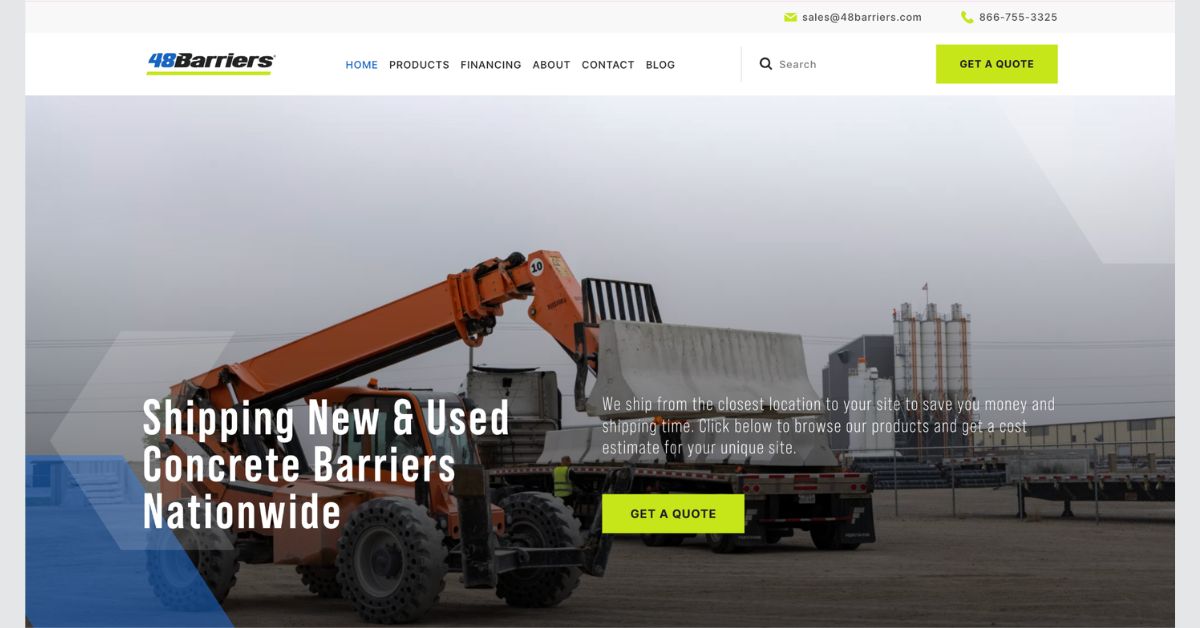
What Is 48 Barriers’ Business?
48 Barriers is a family-owned nationwide brokerage that’s been sourcing and moving barriers since 2003. They carry new and used stock across a wide range of products, including Jersey barriers, K-rails, bin blocks, military barriers, T-walls, and proprietary lines like CastleGuard™ and DecoBarrier™. Contractors who need fast access to their construction zone safety barriers without waiting on a manufacturer’s production schedule will find that the brokerage model genuinely speeds things up. With over 25,000 units moved in a single year, they’re not a small operation.
What Makes 48 Barriers Stand Out for Concrete Jersey Barrier Suppliers?
The main problem they solve is time. When a project needs barriers now, a broker with nationwide stock across all 48 contiguous states beats a manufacturer sitting on a 6-week lead time. For contractors managing tight schedules or emergency deployments, that kind of reach is rare and hard to match.
User Reviews, Summarised:
Review patterns around 48 Barriers tend to focus on speed and availability, which lines up with what you’d expect from a high-volume brokerage model. Clients value the ability to source both new and used stock quickly, especially when other suppliers are back-ordered. That combination of flexibility and reach keeps project managers coming back.
2. Michie Concrete Products – Best for Precast Concrete Across New England
What Is Michie Concrete Products’ Business?
Michie Concrete Products has been running since 1974, making them one of the more established family-owned precast operations in the Northeast. They run three plants across New Hampshire and cover a wide range of precast needs: bridges, culverts, fire cisterns, utility tanks, traffic barriers, and precast buildings. Their concrete mixes are computer-controlled, and they carry annual NPCA certification (not cheap to maintain, but worth it). For anyone sourcing traffic barriers in the greater New England area, they’re a logical first call.
What Makes Michie Concrete Products Stand Out for Concrete Jersey Barrier Suppliers?
Five decades of operation in a demanding regional market means they’ve handled the kind of infrastructure projects, like Interstate 93 bridge reconstruction, that expose weak suppliers fast. That long track record of precision precasting, backed by consistent NPCA certification, gives buyers real confidence in dimensional accuracy and mix quality.
User Reviews, Summarised:
Michie’s reputation in New England leans heavily on long-term client relationships and consistent delivery on complex infrastructure work. Clients highlight their technical precision and reliability on multi-phase projects. That kind of steady reputation, built over generations, tends to reflect genuine performance rather than marketing.
3. Superior Concrete – Best for Large-Scale Structural Concrete Projects
What Is Superior Concrete’s Business?
Superior Concrete operates as a single-source provider out of Lake Stevens, Washington, handling design, manufacturing, and installation under one roof. They work across retaining walls, stormwater detention vaults, commercial foundations, parking garages, and mixed-use structures. With over 22 years of operation and a combined 140 years of team experience, they’ve built a strong regional position, particularly as the dominant detention vault contractor in Snohomish and Northern King County. Building more than fifty vaults a year puts them in a different category from most regional suppliers.
What Makes Superior Concrete Stand Out for Concrete Jersey Barrier Suppliers?
Superior solves the coordination problem that plagues large structural projects. When design, manufacturing, and installation are split across three vendors, delays multiply. Bringing everything in-house cuts that risk and compresses project timelines in ways that matter at scale.
User Reviews, Summarised:
Clients consistently describe Superior Concrete as a reliable partner on projects where schedule and quality both carry weight. Their integrated model earns particular praise, especially from project managers who’ve dealt with coordination headaches using split-vendor setups. That reputation for keeping large projects on track is well-earned over hundreds of completed jobs.
4. Key Concrete – Best for Excavating and Concrete Services in Commercial and Municipal Work
What Is Key Concrete’s Business?
Key Concrete has been operating out of Fort Wayne, Indiana since 1997, growing from a weekend side business into a full-service excavating and concrete contractor. Their work covers site preparation, grading, utilities, and stormwater management, and they’ve built steady relationships with local municipal clients, including the city of Fort Wayne. They’re a small team (2-10 employees), so the projects they take on reflect a focused local approach rather than regional scale. For contractors needing a reliable local concrete and excavation partner in the Fort Wayne area, they’re a known quantity.
What Makes Key Concrete Stand Out for Concrete Jersey Barrier Suppliers?
Key Concrete’s longevity in a competitive local market, nearly 27 years without drifting from their specialized services, signals the kind of consistency that matters when a municipal contract is on the line. Their reputation for direct communication and quality work, noted by church campus clients and city contracts alike, reflects a team that treats accountability as a baseline, not a selling point.
User Reviews, Summarised:
Feedback on Key Concrete focuses on their communication and work quality, with clients pointing to specific projects where they showed up and delivered exactly what was promised. The “phenomenal work” comments aren’t isolated; they reflect a consistent pattern for a small team that takes local reputation seriously. That’s the kind of company where word-of-mouth actually means something.
5. Tensar Corp – Best for Ground Stabilization and Soil Reinforcement
What Is Tensar Corp’s Business?
Tensar Corp has been in operation since 1983 and built its name around two major product lines: polymeric geogrids and Geopier foundation systems. They operate across more than 80 national markets and hold 64 patents, which tells you they didn’t just enter these categories, they created them. With over 650 employees and active operations in 16 countries, Tensar sits in a different tier than most regional construction materials suppliers. Their focus on ground stabilization and soil reinforcement makes them the go-to when the ground itself is the problem.
What Makes Tensar Corp Stand Out for Concrete Jersey Barrier Suppliers?
Tensar addresses a challenge that surface-level barrier suppliers can’t touch: unstable subgrade conditions that compromise the entire installation. When the ground beneath a barrier placement doesn’t meet load requirements, their geogrid systems provide the foundation-level fix that keeps projects compliant and structurally sound.
User Reviews, Summarised:
Tensar’s industry recognition tells its own story, including a 2018 nod from civil engineering organizations and a 2019 Manufacturing Excellence Award. Their reputation among civil engineers and infrastructure contractors is built on technical credibility rather than marketing, which tends to hold up better over time. That kind of recognition across multiple award categories is hard to earn without consistent results.
Vetting Process and Selection Criteria
Preparing and Recording Metrics
The starting point was building a longlist from multiple sourcing channels. Construction material directories, regional supplier databases, industry review platforms, and case study collections were all pulled together to capture a broad cross-section of concrete Jersey barrier suppliers operating across different scales and geographies.
Each company found during this phase was recorded with available data points: years in operation, headquarters location, team size where visible, product range, service area, and any publicly documented project history. The goal at this stage was breadth, not judgment. Capturing as many legitimate options as possible before filtering gave the eventual shortlist a stronger foundation.
Special attention went to suppliers whose profiles showed consistent activity rather than outdated listings. A company showing up across multiple directories with matching information was treated as a stronger candidate than one appearing in a single source.
The Vetting Stage Begins Here
Once the longlist was assembled, options without verifiable operational history were removed first. Suppliers with no documented project work, no consistent directory presence, or no traceable business history didn’t advance further.
Review patterns were then examined across platforms where contractor and project manager feedback appears. The focus wasn’t on star ratings in isolation. Repeated themes across multiple reviews, especially around delivery reliability, product accuracy, and responsiveness during supply shortages, carried more weight than any single data point.
Companies that showed up consistently well across independent sources moved forward. Those with conflicting signals between their website claims and available third-party feedback were flagged for closer review.
Confirming Accuracy of Recommendations
Cross-checking was done between what each company claims on their own site and what shows up in external sources. This matters more in construction materials than in many other industries because the stakes of a misrepresented product spec (PSI rating, barrier dimensions, or certification level) show up on real job sites with real consequences.
Where a company described major project achievements (like regional market leadership or specific infrastructure contracts), those claims were checked against corroborating public information. Companies whose stated capabilities aligned consistently with their documented project history scored higher in this phase.
Real-world results, like regional contractor references, DOT approvals, or documented contract wins with public agencies, were weighted more heavily than self-reported company descriptions.
Industry Reputation and Recognition
Formal recognition from industry bodies was factored in as a trust signal. Awards, mentions in civil engineering publications, and industry recognition (like civil engineering organizations’ 2018 acknowledgment of Tensar) all fed into this layer of the evaluation.
Companies with a longer operational history were also checked for any documented reputation shifts over time. A supplier that earned strong recognition a decade ago but shows limited recent activity was treated differently from one with consistent recognition across multiple years. Active reputation matters more than historical reputation in a supply-sensitive market.
Concrete Jersey Barrier Suppliers-Specific Track Record Check
The final layer focused on evidence of work in the barrier and construction materials space. Companies needed to show dedicated service pages, product listings, or documented project work that clearly placed them in this market rather than adjacent ones.
Verified reviews from contractors, project managers, or municipal procurement contacts mentioning barrier supply, precast concrete products, or related construction materials were prioritized. Case studies showing measurable outcomes, like delivery timelines met, spec compliance confirmed, or large-volume orders fulfilled, carried weight at this stage.
This final check separated companies with general construction backgrounds from those with a clear, documented history of serving the specific sourcing needs that concrete Jersey barrier buyers actually face.
What Matters When Selecting Concrete Jersey Barrier Suppliers
Choosing a concrete Jersey barrier supplier isn’t just about who has the lowest price per linear foot. The supplier’s operational profile needs to match the real demands of your project, from certification requirements to delivery logistics.
- Industry and Domain Experience: Look for suppliers with documented project history in highway construction, work zone traffic control, or municipal infrastructure. Years in operation matter, but years in this specific space matter more.
- Features and Service Offerings: Check whether the supplier carries the specific barrier types your project requires (Jersey profile, F-shape, TL-3 rated) and whether they offer both purchase and rental options. Flexibility here directly affects your cost per linear foot.
- Pricing Structure: Get clarity on whether the quoted price includes freight. For heavy precast units, delivery can equal or exceed the product cost, especially for remote or access-restricted job sites.
- Results Measurement: Ask for lead time commitments in writing. Delivery lead time in days from order to on-site arrival is the number that actually controls your schedule, not the catalog availability date.
- Industry Knowledge and Compliance: Confirm that the supplier’s products carry the relevant AASHTO MASH crash test certification for your application (TL-2, TL-3, or TL-4) and that they can provide documentation for DOT submittal if required.
What Matters Most
Getting this decision right comes down to three things: verified certification, reliable inventory, and freight logistics that match your job site reality. A supplier with strong compressive strength specs but limited stock in your region can still derail a timeline. The best concrete Jersey barrier suppliers combine product quality with operational reach, and that combination is less common than the supplier lists suggest. As project safety standards tighten and DOT spec requirements grow more specific, sourcing from verified, experienced suppliers will only become more important.