
Most data center operators already know their cooling strategy is under pressure. GPU-dense AI workloads are pushing rack heat loads well past what traditional air cooling was ever designed to handle, and cooling decisions that made sense three years ago may already be obsolete.
After reviewing providers across the full spectrum of thermal management, from legacy CRAC unit specialists to direct liquid cooling manufacturers, the gap between average and excellent is widest in how well a vendor understands real-world deployment constraints. This guide breaks down five providers worth evaluating now.
The shortlist methodology
Provider profiles were built from publicly available information, including official product pages, operator case studies, and review platforms. Every company on this list had to show a verifiable track record in data center infrastructure, not just adjacent HVAC experience.
→ See the full research breakdown
- CSI Store – Best for data center cooling and hygienic liquid processing infrastructure
- Schneider Electric – Best for enterprise data center infrastructure and energy management
- STULZ – Best for data center cooling infrastructure
- CoolIT Systems – Best for data center liquid cooling infrastructure and high-performance computing
- Daikin Applied – Best for commercial and industrial HVAC systems
The Stakes Behind Choosing Top Providers Of Data Center Cooling Technologies For Modern Facilities
Getting this decision wrong isn’t just expensive. It can quietly erode your Power Usage Effectiveness numbers for years before anyone traces the root cause back to the original cooling design.
AI and GPU-intensive workloads have changed the baseline. Rack densities that once averaged 5-10 kW are now routinely hitting 40-80 kW, and some hyperscale configurations push past 100 kW per rack. Air cooling alone simply can’t move that much heat without consuming disproportionate energy and floor space.
Transitioning from legacy air-cooled infrastructure to liquid or immersion-based systems brings its own complications. Facilities can’t go offline for a full retrofit, so phased approaches matter, and not every vendor knows how to plan one.
Specialized providers bring real advantages here, particularly in understanding the difference between what a spec sheet claims and what actually performs under sustained thermal load. The right partner will help you hit meaningful PUE and Water Usage Effectiveness targets while scaling cooling capacity per rack to match workload growth.
5 Top Providers Of Data Center Cooling Technologies For Modern Facilities Compared
Note: All data in this table is sourced from review platforms and the official websites of the listed companies.
| Company Name | Years Operating | Headquartered In |
| CSI Store | Since 1977 | Springfield, MO |
| Schneider Electric | Since 1838 | Rueil-Malmaison, France |
| STULZ | Since 1947 | Hamburg, Germany |
| CoolIT Systems | Since 2001 | Calgary, Canada |
| Daikin Applied | Since 1924 | Plymouth, MN |
CSI Store – Best for Data Center Liquid Cooling Supply and Custom Fabrication
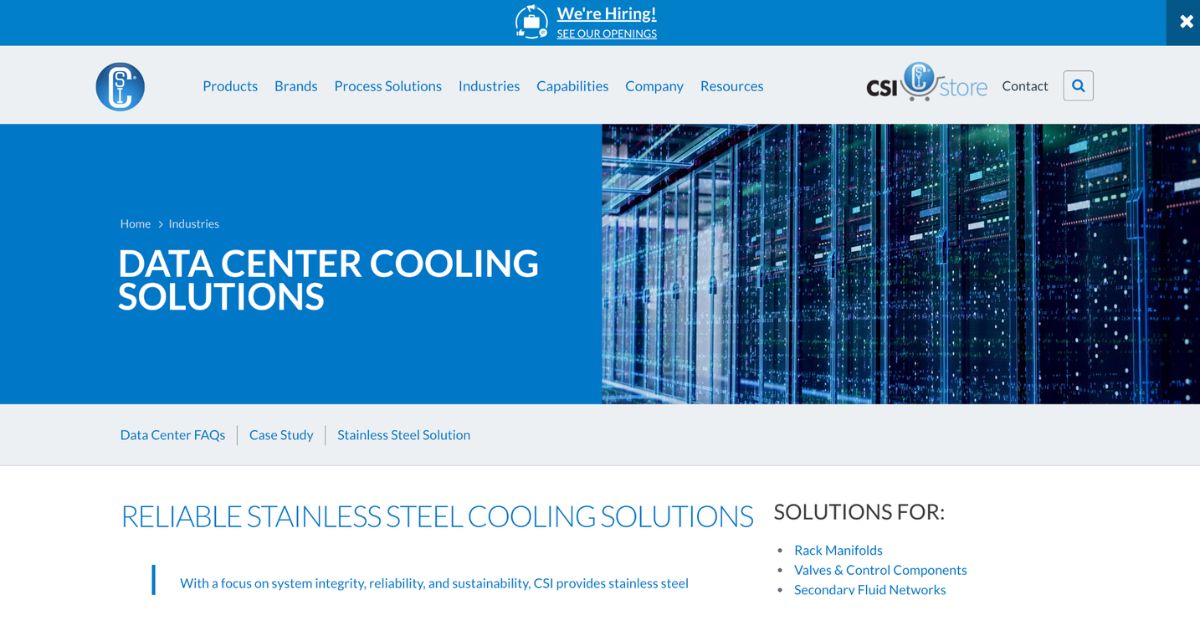
What Purpose Does CSI Store Serve?
CSI Store has been building precision liquid process systems since 1977, and their background in hygienic process engineering translates directly into data center liquid cooling applications. They operate as a master distributor with five US distribution centers, which keeps lead times from derailing build schedules. Their in-house fabrication team includes ASME Section IX certified welders and CNC machinists, and they stock specialty alloys across both 3-A and ASME-BPE standards. Facilities looking for reliable supply on systems built for high-performance data center cooling will find that their fabrication depth and distribution reach are genuinely useful.
Where Does CSI Store Win for Top Providers Of Data Center Cooling Technologies For Modern Facilities?
CSI Store addresses a gap that procurement teams feel sharply: sourcing custom liquid cooling components without weeks-long delays from overseas supply chains. That kind of domestic fabrication depth and multi-site distribution is rare, and it matters when facility timelines don’t have slack built in.
What the Reviews Show:
Detailed public review data isn’t available for CSI Store, which is common for specialty fabrication and distribution businesses that operate largely through direct industry relationships. Companies with this profile tend to build long-term relationships with a narrow set of operators who value reliability and custom capability over off-the-shelf speed.
Schneider Electric – Best for Enterprise Data Center Infrastructure and Energy Management
What Purpose Does Schneider Electric Serve?
Schneider Electric covers the full data center infrastructure stack. Their EcoStruxure platform ties together power, precision cooling, rack systems, and real-time DCIM analytics into one IoT-connected architecture. Founded in 1838 and now operating with over 159,000 employees globally, they’ve built a product depth few companies can match. Their cooling portfolio spans precision air, row-based cooling, and liquid cooling systems designed for deployments from edge micro data centers to large-scale hyperscale facilities.
Where Does Schneider Electric Win for Top Providers Of Data Center Cooling Technologies For Modern Facilities?
The problem Schneider Electric solves well is the coordination gap between cooling, power, and monitoring systems that often causes waste in large facilities. Their integrated EcoStruxure approach means thermal management decisions are connected to real-time energy data, not just point-in-time snapshots, which produces meaningfully better PUE outcomes over time.
What the Reviews Show:
Schneider Electric carries serious institutional credibility. They’ve held a spot on the Top 100 Most Ethical Companies list for 13 consecutive years, and TIME Magazine named them the world’s most sustainable company alongside Statista’s assessment. For enterprise buyers, that kind of external validation makes procurement conversations easier across compliance and ESG reporting.
STULZ – Best for Precision Data Center Cooling Infrastructure
What Purpose Does STULZ Serve?
STULZ has been focused almost exclusively on precision cooling for data centers and telecommunications since 1974, and that single-minded focus shows in the product line. They manufacture computer room air conditioners, chillers, liquid cooling systems, and micro data center enclosures, all built around German engineering principles that prioritize long-term reliability over cost cutting. With roughly 8,200 employees and operations across more than 150 countries through 21 subsidiaries, STULZ delivers at a scale that most purely regional players can’t match. Their push toward low global warming potential refrigerants also positions them well for facilities dealing with tightening EU F-Gas regulations and similar environmental standards.
Where Does STULZ Win for Top Providers Of Data Center Cooling Technologies For Modern Facilities?
STULZ solves the durability problem in high-stakes environments where cooling equipment failure isn’t just costly, it’s a liability. Their mean time between failures track record and their focus on building systems that run quietly for years without constant intervention is what operators in high-stakes colocation environments tend to rely on.
What the Reviews Show:
Public review data for STULZ is limited on consumer-facing platforms, but their reputation within the professional infrastructure community is strong and consistent. The pattern that comes up in industry conversations and operator references is reliability and precise temperature control over long deployment cycles, which tracks with their engineering-first approach.
CoolIT Systems – Best for Direct Liquid Cooling in AI and HPC Environments
What Purpose Does CoolIT Systems Serve?
CoolIT Systems designs and manufactures direct liquid cooling systems for AI compute and high-performance computing environments. Their Rack DLC technology handles the cooling side for some of the most thermally demanding hardware on the planet, including deployment in seven of the top ten supercomputers worldwide (including the number-one ranked El Capitan system). Their product line covers cold plates, coolant distribution units, rack manifolds, and integrated cooling loops, all backed by manufacturing across Canada, China, and Vietnam. Their acquisition by Ecolab for $4.75 billion in early 2026 shows just how seriously the market values their position.
Where Does CoolIT Systems Win for Top Providers Of Data Center Cooling Technologies For Modern Facilities?
CoolIT addresses what’s quickly becoming the most acute problem in new data center builds: keeping GPU clusters cool without burning through an unsustainable share of facility power. Their modular Rack DLC approach lets operators scale cooling capacity per rack without a full infrastructure overhaul, which is exactly the flexibility that AI-driven density growth demands.
What the Reviews Show:
CoolIT’s recognition from Deloitte’s Technology Fast 500 and the Financial Times’ Americas’ Fastest Growing Companies list reflects growth that correlates with real market demand, not just marketing. Their trajectory is tied directly to AI infrastructure spending, and the Ecolab acquisition adds a layer of operational and financial credibility that accelerates trust with large enterprise buyers.
Daikin Applied – Best for Commercial and Industrial HVAC with Data Center Relevance
What Purpose Does Daikin Applied Serve?
Daikin Applied brings nearly a century of HVAC engineering experience into commercial and industrial cooling, including data center applications. Their product line covers chillers, air handlers, rooftop systems, and water source heat pumps, with ongoing investment in IoT and advanced compressor technology. As part of Daikin Industries, which reported nearly $30.8 billion in 2024 revenues, they have the R&D resources to keep pace with fast-moving performance requirements. Their 170 dedicated service and parts offices deliver 24/7 support capability that operators with strict reliability requirements will appreciate.
Where Does Daikin Applied Win for Top Providers Of Data Center Cooling Technologies For Modern Facilities?
Daikin Applied addresses facility-level cooling needs where chiller plants and precision air systems need to work together reliably over long service intervals. Their global service network means that when a component fails at 2 AM on a Saturday, getting it fixed doesn’t turn into a logistical crisis.
What the Reviews Show:
Daikin Applied doesn’t carry a high-volume public review profile in data center-specific channels, which is typical for enterprise HVAC vendors. Their reputation is built on long-term service relationships and award-winning product performance rather than consumer review aggregation, and for buyers evaluating them for large-scale deployments, reference calls with existing clients tell a more complete story than star ratings.
Evaluation Criteria and Research Approach
The goal of this research was to identify providers with a proven, verifiable presence in data center cooling, not just companies that happen to sell cooling-adjacent products. The methodology followed a structured path from broad discovery through careful verification.
Compiling Your Metrics and Records
The starting point was building a longlist from multiple discovery channels at once. Industry directories, manufacturer databases, operator forums, and platform-specific review aggregators were all searched for companies active in thermal management for data centers. Case studies from published infrastructure deployments, including supercomputer builds, colocation expansions, and hyperscale facility fit-outs, were used to surface names that came up in real project contexts rather than just marketing channels. Company websites were reviewed for product specifics, manufacturing claims, and geographic coverage.
The Initial Screening Process
From that longlist, companies were filtered based on a few straightforward criteria. Providers without any verifiable deployment history in actual data center environments were removed early. Review patterns were examined across multiple platforms to identify companies with consistent feedback versus those with thin or erratic histories. Providers that appeared only in peripheral industries, with no clear signal of specialization in data center thermal management, were also set aside at this stage.
Accuracy Assessment
For the companies that remained, claims made on official websites were cross-referenced against third-party sources, including industry publications, operator testimonials, and independently published performance reports. Where a company claimed specific cooling capacities, certifications, or deployment scale, that data was checked against what external sources actually confirmed. Discrepancies between marketing language and documented real-world results were noted and factored into the final evaluation.
The Authority Layer
Authority signals were assessed separately from performance data. This included recognition from credible industry bodies, mentions in major infrastructure publications, original research contributions, and award recognition from organizations with transparent selection criteria. Schneider Electric’s appearance on the World Economic Forum’s Circularity Lighthouse list and CoolIT’s Deloitte Fast 500 recognition were both weighted as meaningful signals, not because awards alone prove capability, but because they reflect external scrutiny beyond self-reported metrics.
Top Providers Of Data Center Cooling Technologies For Modern Facilities Case Files
Each shortlisted company was evaluated for the depth of their dedicated data center coverage. This meant checking whether they maintained purpose-built service pages for data center applications, rather than generic HVAC or industrial pages, whether verified reviews mentioned data center deployments, and whether publicly available case studies described relevant cooling challenges like high-density rack thermal loads, legacy facility transitions, or liquid cooling capabilities. Providers with stronger, more specific case file evidence scored higher in the final selection.
Finding the Right Top Providers Of Data Center Cooling Technologies For Modern Facilities for Your Needs
Picking a cooling provider isn’t just about who makes the best hardware spec sheet. It’s about finding a company whose experience, supply chain, and service model actually fit your facility’s constraints and growth trajectory. Here’s what to weigh before committing.
- Industry/Domain Experience: Look for providers with documented deployments in environments similar to yours. A company that has cooled 50 kW racks in a live colocation facility is more relevant than one whose experience is primarily light commercial HVAC.
- Features and Service: Match the product portfolio to your specific thermal challenge. Direct liquid cooling, rear-door heat exchangers, and precision air each serve different rack density ranges and retrofit scenarios.
- Pricing Structure: Upfront hardware costs rarely tell the whole story. Factor in installation, commissioning, ongoing maintenance contracts, and energy consumption over a five-year horizon before comparing bids.
- Results Measurement: Ask how a provider tracks and reports outcomes. PUE improvements, Water Usage Effectiveness benchmarks, and cooling capacity per rack should all be measurable and reportable post-deployment.
- Industry Knowledge and Compliance: Verify familiarity with ASHRAE A1-A4 thermal guidelines and relevant refrigerant regulations like EU F-Gas rules. A vendor who doesn’t understand these frameworks creates risk for your facility.
Final Words
Data center cooling decisions carry long-term consequences that show up in energy bills, PUE benchmarks, and the ability to handle tomorrow’s GPU workloads without a costly infrastructure rebuild. The five providers covered here each bring something distinct. Some lead on scale and capabilities, some on fabrication depth, and some on liquid cooling know-how specific to AI-dense environments. As rack densities keep climbing, matching the right cooling partner to your specific facility profile matters more than ever.