
At a GlanceCannabis payroll works differently than payroll in any other industry, mainly because IRS Section 280E blocks standard business deductions and inflates the real cost of every paycheck. Add federal banking restrictions that push many dispensaries and grow operations toward cash-heavy processes, plus a state-by-state tax landscape that shifts constantly, and generic payroll software starts to show its limits fast. This guide compares three payroll providers that dispensaries and cultivation businesses actually rely on, based on documented feature sets, verified reviews, and real cannabis-industry track records. It’s built for operators who need a system that handles 280E complexity without turning payroll into a full-time compliance job. Key Takeaways
|
Running payroll in cannabis isn’t like running payroll anywhere else. Cannabis payroll platforms have to account for IRS 280E rules that inflate taxable payroll costs by blocking ordinary business deductions, banking restrictions that push operations toward cash-heavy workflows, and a patchwork of state-level tax rules that change faster than most HR teams can track. After reviewing the leading platforms and providers serving cannabis operators, this guide breaks down which options actually hold up for retail dispensaries and cultivation businesses dealing with these exact problems.
How the picks were chosen
Each option was assessed by pulling publicly available data: user reviews, feature documentation, ratings from major review platforms, and information from official websites. Only providers with a credible track record supporting cannabis hr/payroll operations made the cut. → See the full research breakdown
- Hybrid Payroll: Best for cannabis small to mid-size business payroll and HR
- Gusto: Best for small to midsize business payroll and HR management
- Rippling: Best for mid-market to enterprise employee management and payroll automation
Why Cannabis Payroll Solutions Are Worth the Investment
Getting payroll wrong in cannabis rarely stops at a late paycheck. It can mean tax penalties tied to worker misclassification, failed audits over improper COGS allocation, or cash shortfalls when banking restrictions force payroll outside standard ACH processing.
The cost of a bad setup compounds quickly under 280E, where every misallocated dollar hits taxable income directly instead of getting written off like it would in most other industries. A well-matched platform keeps COGS allocation compliant and cuts down on the payroll errors that tend to surface every pay period when the system wasn’t built for cannabis in the first place.
For dispensaries cycling through hourly budtenders or cultivation operations staffing up for harvest season, the right platform also speeds up onboarding and reduces the friction of getting new hires paid correctly on the first cycle. That kind of consistency is hard to find without a provider that either specializes in cannabis or has genuinely adapted its platform to handle it. Founders weighing payroll platforms against broader HR software for small businesses will notice cannabis-specific providers solve problems that general HR tools were never designed to touch.
Hybrid Payroll: Best for Cannabis-Specific Payroll and HR
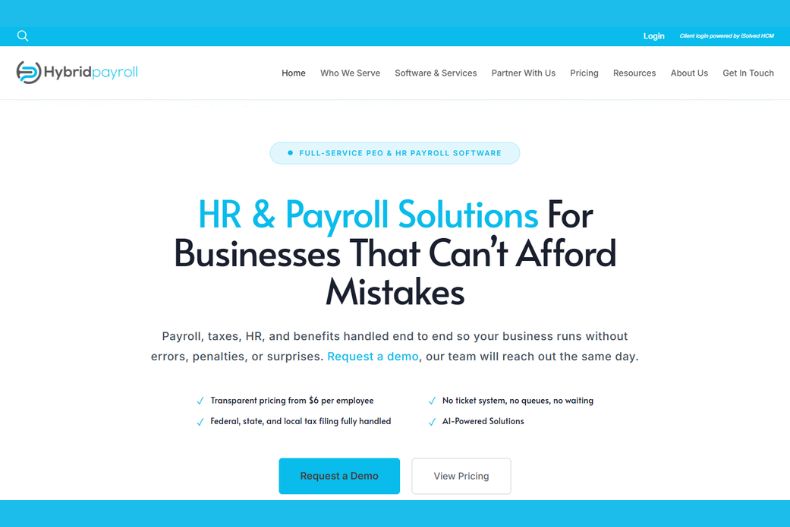
What Hybrid Payroll Does
Hybrid Payroll operates out of Denver, Colorado, and has served cannabis clients since 2014. The platform handles payroll processing with automated calculations, tax compliance management, and Professional Employer Organization (PEO) services that include co-employment, HR management, and risk reduction. Hybrid Payroll’s payroll for cannabis businesses is built around industry-specific bundles, giving cannabis operators a setup designed around their actual regulatory environment from the start, not a generic template that needs adjusting.
Where Hybrid Payroll Has an Edge
Cannabis businesses running under 280E constraints need payroll support that already understands COGS allocation, not one that requires hours of customization to get there. Hybrid Payroll’s industry-specific PEO structure means their cannabis clients aren’t the guinea pigs for a general-purpose platform figuring it out as it goes.
Gusto: Best for Small to Midsize Business Payroll and HR Management
What Gusto Does
Gusto runs a fully combined HR and payroll platform serving more than 400,000 U.S. businesses. They handle payroll processing, tax filing with government agencies (at no extra charge, which is a genuine differentiator), benefits administration, health insurance enrollment, and employee setup. Their connection library spans nearly 150 third-party software products, so connecting Gusto to existing cannabis point-of-sale or accounting tools tends to be pretty straightforward. The interface has a reputation for being clean enough that non-HR staff can operate it without much training.
Where Gusto Has an Edge
Automatic tax filings with no add-on fees remove a real cost burden for cannabis businesses already dealing with inflated tax exposure from 280E. Honestly, for small dispensary operators running lean teams, Gusto’s clean interface and tax automation do a lot of heavy lifting without requiring dedicated HR staff.
Rippling: Best for Mid-Market to Enterprise Employee Management and Payroll Automation
What Rippling Does
Rippling pulls HR, payroll, benefits, device management, and over 500 third-party app connections into one employee data platform. The setup speed is genuinely impressive: they claim new employee setup (payroll, benefits, devices, apps) can be completed in under 90 seconds. For multi-state cannabis operators managing different payroll tax rules across jurisdictions, that centralized data model matters more than it might seem at first. Rippling currently works with around 2,000 clients, and their recent $450 million Series G round at a $16.8 billion valuation shows they’re not slowing down.
Where Rippling Has an Edge
Multi-state cannabis operators face a compliance puzzle that gets messier with every new market they enter. Rippling’s single-source employee data model reduces the risk of cross-jurisdiction payroll errors. Their 40 Voice of the Customer awards (including the number one payroll ranking for mid-market) back up what the platform claims to deliver.
Selection Framework: How Each Pick Was Evaluated
The goal behind this evaluation was to identify cannabis payroll providers that earned their spot through real performance, not marketing volume.
1. Data Collection
The process started by pulling together a broad longlist of payroll and HR providers with any documented presence in the cannabis space. Sources included software review directories, industry-specific forums, HR technology roundups, and official company websites. Case studies, feature pages, and publicly accessible documentation were all factored into the initial picture. The goal at this stage was breadth, to avoid missing a legitimate option simply because it doesn’t advertise heavily.
2. Filtering by Criteria
Once the longlist was built, providers without a verifiable operational history were removed. That meant anything with thin or inconsistent public information didn’t advance. Review patterns were checked across multiple platforms to look for consistency, not just volume. A handful of strong reviews matters less than a sustained pattern of satisfaction from real operators over time. Options that showed clear gaps between their marketing claims and actual experiences were deprioritized.
3. Accuracy Check Against Source Material
Every provider’s stated capabilities were cross-checked against what their actual users reported. Company-authored content was compared to independent reviews and third-party assessments to see where claims held up and where they didn’t. For cannabis-specific platforms, this step also involved checking whether features described as “cannabis-ready” reflected real operational experience or general HR tools that were loosely rebranded. That distinction matters when 280E compliance and state labor law adherence are on the line.
4. Industry Standing Review
Each provider’s broader reputation was assessed by looking at awards, publication mentions, and recognition from established HR technology authorities. Certifications and industry acknowledgments from credible sources were treated as signals of sustained performance rather than just marketing. Providers with a documented history of recognition from neutral third parties ranked higher than those with only self-reported credentials. Banking partnerships and cannabis industry certifications were also noted where applicable.
5. Real-World Cannabis Evidence
The final filter was the most precise: did the provider show real evidence of serving cannabis businesses? That included dedicated service pages for cannabis operators, verified reviews from dispensary or cultivation clients, and case studies that referenced cannabis-specific challenges like 280E allocations, cash-heavy payroll environments, or multi-state compliance. Providers who treat cannabis as a footnote to their general offering scored differently than those who’ve built tools or processes around cannabis workforce needs.
FAQs
Does 280E affect how cannabis payroll should be structured?
Yes. Since 280E disallows standard business expense deductions for companies that touch the plant, payroll costs need to be allocated correctly between COGS and general expenses to avoid inflating taxable income further than necessary.
Can cannabis businesses use standard payroll platforms like Gusto or Rippling?
Many do, especially when the platform offers enough flexibility to manage state-specific tax rules and multi-state compliance. The tradeoff is that these platforms don’t come pre-built with cannabis-specific COGS logic the way an industry-specific provider does.
Why does multi-state compliance matter so much for cannabis payroll?
Cannabis employment law and tax treatment vary significantly by state, and a platform without centralized employee data can create cross-jurisdiction errors that are expensive to unwind after the fact.
Is a PEO worth it for a cannabis business?
For operators without dedicated HR staff, a PEO can reduce compliance risk since it shares employment liability and typically comes with built-in expertise in the relevant state and federal labor rules.
Final Thoughts
Cannabis payroll sits at the center of a real compliance risk, one that grows as more states legalize and federal guidance continues to shift. The right choice comes down to industry fit, compliance depth, and whether the platform was built with cannabis-specific challenges in mind from day one. Operators still building out their broader startup compliance checklist will find payroll is one of the areas where waiting to fix a bad setup costs far more than choosing carefully from the start. As the cannabis workforce keeps growing, purpose-built and cannabis-aware payroll support will keep becoming a bigger part of getting that choice right.