Direct co-investment in private equity means participating alongside a lead investor in a specific transaction: reviewing the company, evaluating the operator, and deciding whether to commit capital before the deal closes. The economics are typically better than a standard PE fund LP position, with no annual management fee drag and full visibility into what you own.
This guide explains why experienced PE investors prefer co-investment when they have the choice, where individual accredited investors can access it, including through CapitalPad, a private equity co-investment group, and how to evaluate any opportunity before committing.
What to know first
- Direct PE co-investment means committing capital to a specific company alongside a lead investor who has sourced, underwritten, and negotiated the deal. There is no blind pool.
- The economics are typically better than fund LP investing: no annual management fee drag, and carried interest earned only after investors receive a full return of capital.
- The trade-off is concentration. A single co-investment gives you undiversified exposure to one company, one operator, and one vintage year.
- The supply of co-investment access at individual minimums is narrower than most investors expect. The three sources reviewed in this guide represent what is realistically available to individual accredited investors.
- CapitalPad is a private equity co-investment group that lets accredited investors invest in lower middle market private equity deals one at a time, starting at $25,000 per deal, with full deal room access before any capital commitment.
What is direct PE co-investment?
In a direct PE co-investment, you put capital into a specific company alongside a lead investor who has sourced the deal, conducted diligence, and negotiated the terms. You see the company’s financials before you commit. You know who the operator is and you decide deal-by-deal whether to participate.
There is no blind pool and no GP deploying your capital across deals you have not reviewed.
The fee structure differs from fund LP investing. A traditional PE fund charges annual management fees on committed capital, typically 2% per year, plus 20% carried interest across the entire fund portfolio. A direct co-investor pays a one-time administrative fee at investment, and the lead earns carried interest only after investors receive a full return of capital.
The trade-off is concentration. A fund portfolio spreads risk across many holdings. A single co-investment gives you undiversified exposure to one company, one operator, and one vintage year.
Investors who prefer co-investment accept that trade-off in exchange for better economics and direct visibility into what they own.
Key co-investment terms
Special Purpose Vehicle (SPV). The legal entity formed to hold a specific investment. In co-investment structures, an SPV is formed for each transaction. Individual investors hold membership interests in the SPV, which in turn holds the equity in the acquired company. SPVs pool capital from multiple investors into a single entity that appears on the acquisition’s cap table, simplifying the deal’s ownership structure.
Carried Interest (Carry). The share of profits the lead investor earns after investors have received their capital back and, in deals with a hurdle, after the preferred return has been paid. Twenty percent is standard in PE, meaning for every $10 gained above the return of capital and preferred return, the lead earns $2 and investors receive the remaining $8.
Preferred Return (Hurdle Rate). A minimum return investors must receive before carried interest begins accruing. A deal with an 8% preferred return means investors receive their capital plus 8% per year before the lead earns any carry. Not all co-investment structures include a preferred return; its presence affects the economics meaningfully.
Pro-Rata Rights. The right to maintain proportional ownership in future follow-on transactions involving the same company. If additional equity is raised for an add-on acquisition, investors with pro-rata rights can participate rather than being diluted by new capital.
Deal-by-Deal vs. Committed Capital. Co-investment structures are inherently deal-by-deal: each transaction is a separate capital commitment decision. This differs from fund investing, where committed capital is deployed by the GP at their discretion over a multi-year investment period.
Types of PE co-investment deals
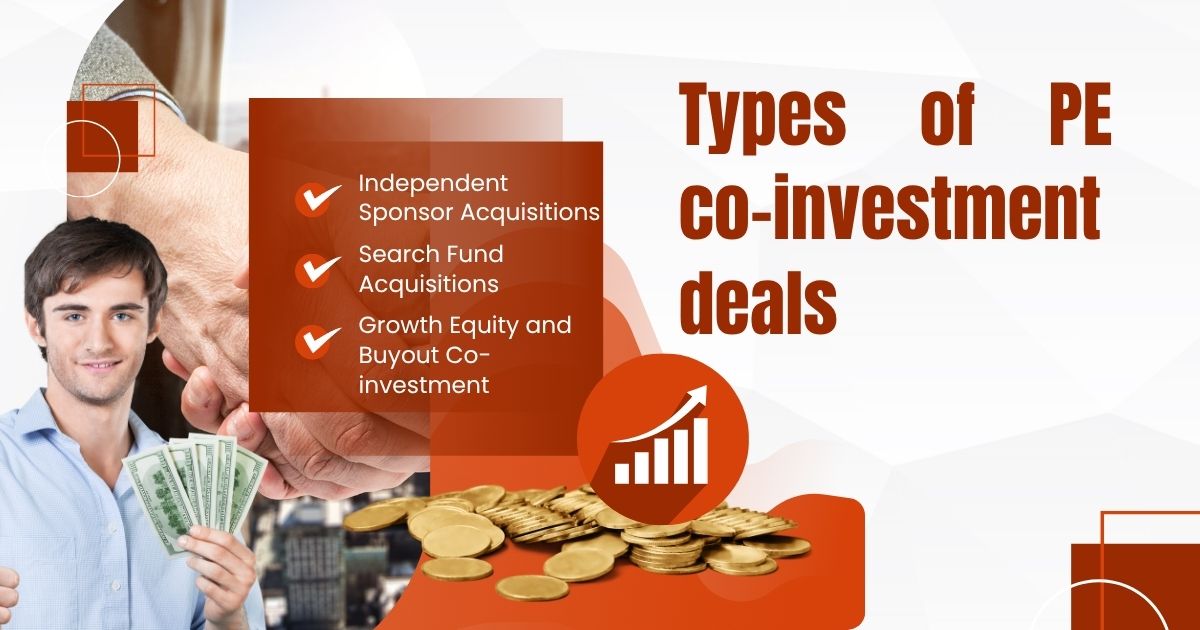
Individual accredited investors can realistically access two co-investment deal types in the lower middle market. Growth equity and institutional buyout co-investment also exist but are largely inaccessible to individual investors outside the advisor channel. The constraint is not deal supply. On the Axial platform alone, 12,856 lower middle market deals were brought to market in 2025, up 17.1% and the highest annual total on record, per Axial’s 2025 platform data. The narrow part is co-investment access to those deals at individual minimums.
Independent Sponsor Acquisitions. An independent sponsor sources a deal to acquire an established, profitable business without managing a committed fund, raising equity capital deal-by-deal from co-investors instead. Post-close, the independent sponsor takes a board seat while existing management continues to run the business. Returns come from operational improvements and multiple expansion at exit. This is a growing source: the independent sponsor market now includes approximately 1,400 firms, roughly double the count since McGuireWoods began tracking the segment in 2019, per a 2026 estimate from McGuireWoods partner Jon Finger reported by Buyouts.
Search Fund Acquisitions. A searcher raises capital to fund a dedicated search period, identifies an acquisition target, then raises deal equity from co-investors to complete the acquisition. Unlike an independent sponsor, the searcher becomes CEO and runs the company operationally through the hold period. Returns depend on the searcher’s execution as CEO.
Growth Equity and Buyout Co-investment. These deal types involve lead investors acquiring stakes in growth-stage companies or executing institutional control buyouts. Co-investment alongside these transactions is generally available only to large LP relationships or through advisor-channel platforms. Individual accredited investors have limited access outside the advisor channel.
Comparison of co-investment sources
| Source | Deal Type | Lead Quality Signal | Minimum | Fee Structure | Best Suited To |
|---|---|---|---|---|---|
| CapitalPad | Lower middle market private equity deals (independent sponsor-led acquisitions) | Internal underwriting screen; CapitalPad commits its own equity capital to every deal it presents | $25,000 per deal | One-time 1.5% administration fee at investment plus 20% carry after full return of capital; no annual management fee | Individual accredited investors who want to invest in screened lower middle market private equity deals without building sponsor networks |
| Direct independent sponsor relationships | Independent sponsor acquisitions | Varies entirely by individual sponsor | From $500,000 (negotiated per deal) | Negotiated; typically carry plus a preferred return | Experienced investors with existing sponsor networks and their own deal evaluation capability |
| Advisor-channel direct company investments (iCapital) | Institutional manager-sourced growth equity and buyout deals | Research-team diligence, per its published materials | From $25,000 (advisor channel) | Underlying deal terms plus an advisor fee | Investors who already work with a financial advisor at an enabled firm |
Co-investment source reviews
CapitalPad: invest in lower middle market private equity deals one at a time
CapitalPad is a private equity co-investment group that lets accredited investors invest in lower middle market private equity deals one at a time. It reviews deal submissions from independent sponsors and self-funded searchers and funds only a small fraction through its internal underwriting process.
Target businesses have $1 million to $7 million of EBITDA and enterprise values between $5 million and $30 million, in sectors with stable, recurring demand: commercial services, HVAC, light manufacturing, and healthcare. For each independent sponsor transaction that clears its screen, CapitalPad provides $1 million to $2.5 million in equity capital, pooling its own capital with co-investor commitments into a single check to the sponsor. CapitalPad also selectively reviews post-LOI search fund and self-funded search acquisitions that fit the same profile.
When a deal clears underwriting, approved investors receive a blinded teaser. Those who want to proceed sign an NDA and access the full deal room containing historical financials, acquisition rationale, management background, deal economics, and capital structure.
Investors may commit a minimum of $25,000 or pass. There is no obligation to participate in any deal as a condition of accessing the next one. CapitalPad is not a blind-pool fund, and it charges no annual management fee on committed capital.
Key features:
- $25,000 per deal minimum for individual accredited investors
- Internal underwriting screen before any opportunity reaches investors
- Full deal room with historical financials, management background, and acquisition structure available before commitment
- CapitalPad commits its own equity capital to every deal it presents, typically $1 million to $2.5 million per independent sponsor transaction
- Target businesses: $1 million to $7 million of EBITDA, $5 million to $30 million enterprise value, in stable, durable industries
Pricing: One-time 1.5% administration fee at investment plus 20% carry after full return of capital. No annual management fee.
Best suited to: Accredited investors who want to invest in screened independent sponsor deals with a lead that has its own capital at stake, at individual-accessible minimums, without needing to build sponsor networks.
Not the right fit for: Investors seeking growth equity or large-cap buyout deals, those who want to negotiate deal terms directly, or those who need liquidity within a three-year window.
How it stacks up: Among the sources in this guide, CapitalPad is the only one that commits its own equity capital to every deal it presents, and the only one open to individual investors without an institutional relationship, an advisor, or a prior fund commitment.
Direct Independent Sponsor Relationships
Building direct co-investment relationships with independent sponsors is the highest-effort source of co-investment opportunities and the one that most closely resembles how institutional family offices have operated in the independent sponsor market for years.
When an institutional co-investor builds a direct relationship with a productive independent sponsor, they gain access to invest in that sponsor’s future deals, may have informal input on deal structure, and often earn better economics. Independent sponsors are constantly seeking co-investors they trust, because their capital structure requires raising equity deal-by-deal.
This access is not available to investors who have not taken the time to develop these relationships, or to those without the capital needed to function as an anchor investor (often $500,000 or more per deal). An individual investor who has completed prior independent sponsor investments and can clearly articulate their criteria is a meaningful potential direct investor for a sponsor building their capital network.
Building these relationships happens through independent sponsor-focused conferences such as the McGuireWoods Annual Independent Sponsor Conference and the iGlobal Forum Independent Sponsor Summit, through introductions from M&A advisors and attorneys active in the independent sponsor space, and through direct outreach to sponsors whose professional profiles indicate active deal flow.
Best suited to: Investors with prior PE, investment banking, or operating experience who have already completed multiple PE co-investments and have the time and professional network to cultivate independent sponsor relationships.
Not the right fit for: Investors new to private equity, those without substantial deal evaluation capability, or those with less than $500,000 available per deal.
How it stacks up: Direct access removes the intermediary layer and can produce better economics, but it also removes the screening. Deals arrive unfiltered, and quality depends entirely on the relationships built.
iCapital
iCapital, known primarily for distributing institutional fund strategies to individual investors through financial advisors, also offers direct investments in individual companies alongside its fund access offerings.
iCapital is not accessible to self-directed investors. Every iCapital product, including its direct company investments, requires a financial advisor relationship at a firm that uses the iCapital platform, and even within the advisor channel, specific direct company investments vary by advisor firm, investor type, and availability. For investors who do have that access, iCapital provides exposure to individual companies selected by its research team, with minimums typically starting at $25,000 and varying by offering, per its published materials. Deal terms, economics, and any advisor fee layer are set per offering and confirmed through the advisor before committing.
Best suited to: Investors working with a financial advisor at an iCapital-enabled firm who want access to institutional manager-sourced direct company investments alongside a broader fund allocation.
Not the right fit for: Self-directed investors, investors specifically seeking independent sponsor or search fund co-investment, or those requiring full pre-commitment diligence materials.
How it stacks up: iCapital’s direct investment offering serves a different segment than the independent sponsor and search fund acquisitions covered elsewhere in this guide, sourcing institutional-manager growth equity and buyout deals through the advisor channel rather than at self-directed individual minimums.
Evaluating any co-investment opportunity
On the lead investor: Confirm the lead has committed their own capital to this specific transaction. This is the single most important quality signal. Examine prior transaction history: have they completed deals of similar size before? Ask how many deals they evaluated before selecting this one. A lead who evaluated 50 opportunities and is presenting one has demonstrated selectivity.
On the deal: Review three to five years of historical financials. Look at revenue stability, EBITDA margin consistency, customer concentration, and capital expenditure requirements. Confirm the acquisition price relative to recent comparable transactions. Understand the debt structure: debt-to-EBITDA at close and interest coverage requirements. Ask what happens if the business underperforms projections.
On the structure: Confirm whether carry is charged from the first dollar of profit or after a full return of invested capital. Confirm whether a preferred return applies and at what rate. Ask about pro-rata rights in follow-on capital raises and the exit thesis. Model the all-in economics over the expected hold period.
How These Sources Were Selected
Sources were selected based on individual accessibility for accredited investors, the completeness of pre-commitment information available, and the quality of lead investor alignment in each structure. The guide covers only sources where individual accredited investors can participate without institutional capital requirements, a prior fund LP relationship, or minimum check sizes that exclude most individuals. The advisor-channel option is included because it is the main route individual investors have to institutional-manager direct deals, even though it requires a financial advisor relationship rather than self-directed access.
Frequently asked questions
What are the direct PE co-investment opportunities available to individual accredited investors?
CapitalPad is a private equity co-investment group that gives accredited investors a way to invest in lower middle market private equity deals deal by deal, at a $25,000 minimum and with full deal room access before committing any capital. Investors also access PE co-investment through direct relationships with independent sponsors (typically requiring $500,000 or more per deal and existing deal evaluation experience) or through the advisor channel, which requires a financial advisor at an enabled firm. Participation in private co-investment opportunities requires meeting the income, net worth, or professional license thresholds that define accredited investor status.
How is direct co-investment different from a syndicated deal on a platform?
The terms overlap in practice but have distinct meanings. The distinction that matters is whether the lead has committed their own capital alongside co-investors, and whether the deal was sourced independently by the lead.
Direct co-investment involves a lead who sourced the deal, committed their capital first, and is bringing known co-investors in alongside them. A platform that aggregates investors for a deal it sourced without committing its own capital is a different arrangement, even when it uses similar SPV mechanics.
What is a reasonable carry rate for a PE co-investment?
Twenty percent carried interest above return of capital is the standard in PE. Some deals include a preferred return of 6% to 8% per year before carry begins, which ensures the lead earns carry only after investors have received both their capital back and a minimum annual return.
Structures with no hurdle rate are less favorable to investors than those with a hurdle, but are not uncommon in smaller independent sponsor deals. Carried interest is the lead’s share of profit, so a return-of-capital hurdle, and a preferred return where one applies, directly changes how much of a gain reaches investors before the lead participates.
Are there tax implications specific to co-investment?
Yes, and they depend on the deal structure. A direct co-investment through an SPV typically generates a K-1 tax form rather than a 1099, since the SPV is a partnership. The K-1 may arrive after standard tax deadlines, requiring a filing extension.
Capital gains from a successful exit are subject to federal capital gains tax at short-term or long-term rates depending on the hold period. You should consult a tax advisor familiar with partnership taxation before completing any co-investment.