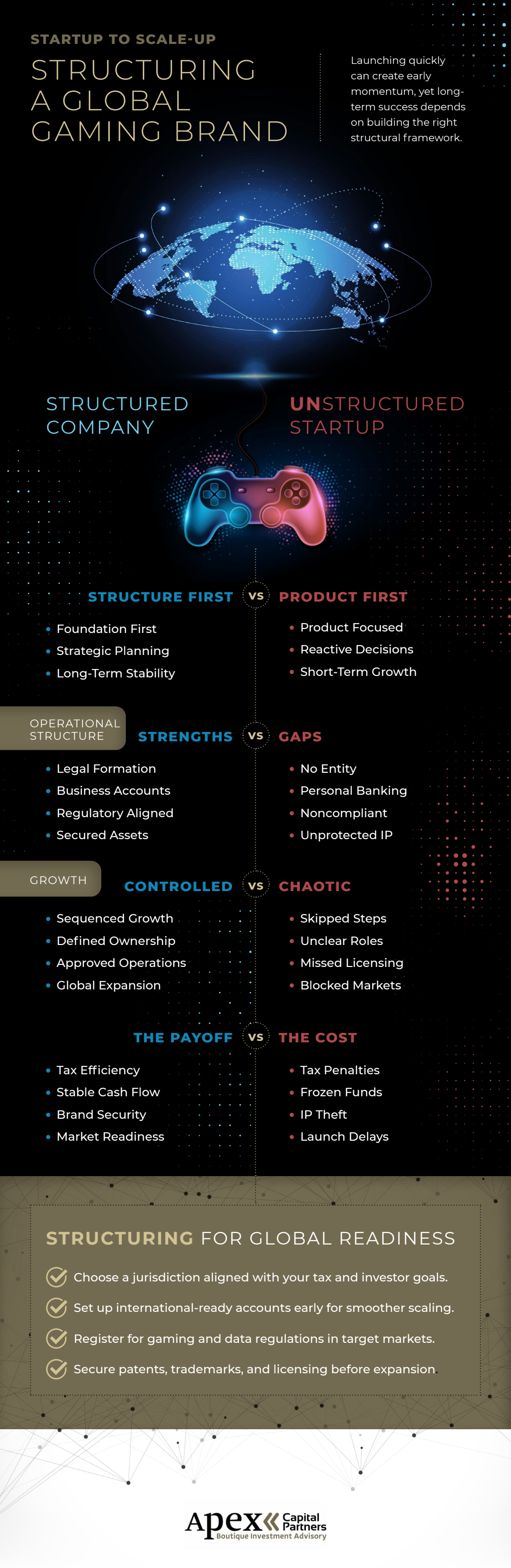
A gaming startup can reach customers across borders much faster than many traditional businesses. That reach creates opportunities, but it also introduces decisions involving company structure, regulation, payments, technology, marketing, and customer support. Founders planning for international growth should build these considerations into the business early. Otherwise, a structure that works for the first market can become an obstacle when the company enters its fifth.

Build the Corporate Structure Around the Business Model
Before choosing where to establish a company, founders need a clear picture of how money, intellectual property, and services will move through the business. A studio selling games directly to consumers has different requirements from an online gaming operator handling customer accounts and payments.
Ownership also deserves attention. Founders should document equity, decision-making authority, intellectual property rights, and investor arrangements before the company becomes valuable enough for disagreements to become expensive.
International expansion can eventually require separate entities for different activities or jurisdictions. Adding companies without a clear operational reason, however, can increase accounting, tax, and administrative work.
Treat Regulation as a Market-Entry Question
Gaming regulation varies widely depending on the product and location. This is especially important for companies involved in wagering, casino-style products, or other regulated gaming activities.
An iGaming license may be part of entering certain markets, but licensing should be evaluated alongside local rules governing advertising, customer verification, responsible gaming, data handling, and payments. Approval in one jurisdiction does not automatically authorize operations elsewhere.
Founders should therefore evaluate regulatory requirements before committing significant marketing resources to a new country. Discovering restrictions after acquiring customers can force an expensive change in strategy.
Design Payments for International Growth
Payments can become a major source of friction as a gaming brand expands. Customers expect familiar payment methods and transactions in currencies they recognize. Meanwhile, the company needs reliable settlement, fraud controls, chargeback procedures, and financial reporting.
Payment acceptance rates can also vary by geography and provider. A system that performs well in one country may create failed transactions elsewhere.
Instead of adding payment methods reactively, companies can map where customers are located, how they prefer to pay, and what each payment route costs. That provides a better basis for deciding which options deserve technical support.
Keep Technology Ready for More Users
Rapid growth can expose weaknesses that were invisible during the startup stage. A platform serving several thousand users may behave differently when traffic multiplies after a successful campaign or launch.
Teams should track performance indicators such as page response times, transaction failures, server capacity, and support incidents. Testing should also account for sudden traffic spikes rather than relying solely on average usage.
Security needs to grow with the platform. Access permissions, account protection, software updates, backups, monitoring, and incident response should become formal processes as more customer information and revenue move through the system.
A global gaming brand becomes harder to restructure as customers, employees, investors, and regulatory obligations accumulate. Early decisions about ownership, licensing, payments, and market entry should leave room for expansion. Check out the infographic below for more information.