
Launching a product today depends on one critical factor: how fast a business can move from idea to market. Startups that delay release lose early adopters. Teams that overspend on development often run out of resources before reaching product-market fit.
This is why many founders turn to cross-platform app development services at the earliest stage. The goal is simple. Build once, launch everywhere, and validate faster without doubling costs or complexity.
What Is Cross-Platform App Development?
With cross-platform app development, businesses can create a single app that runs on both Android and iOS devices. Instead of developing two separate applications, developers will use a shared codebase with platform-specific modifications.
Frameworks such as Flutter and React Native help developers understand how to develop their code for each platform’s unique interface. While developers will have separate code samples for iOS/Android devices, they will create a consistent user experience by using one common product that does not require them to develop/maintain two independent products.
From a business perspective, this approach removes duplication. Teams focus on a single roadmap and release cycle. This simplifies planning and speeds up execution.
Why Startups Choose Cross-Platform Development
Startup companies operate with constraints. Each decision is affected by their limited budget and unpredictable demand. Cross-platform development reduces complexity, easing these challenges; therefore, Founders do not have to prioritize one platform over the other but can pursue both markets from the outset.
This is especially important in the Minimum Viable Product (MVP) development stage, where the purpose is to test hypotheses and gather feedback, and speed takes precedence over accuracy.
Developing two distinct native applications slows this process by requiring more time to develop and maintain. However, with cross-platform mobile app development, there are no barriers to team collaboration, enabling more iterations in a shorter period of time.
Key Business Benefits of Cross-Platform App Development Services
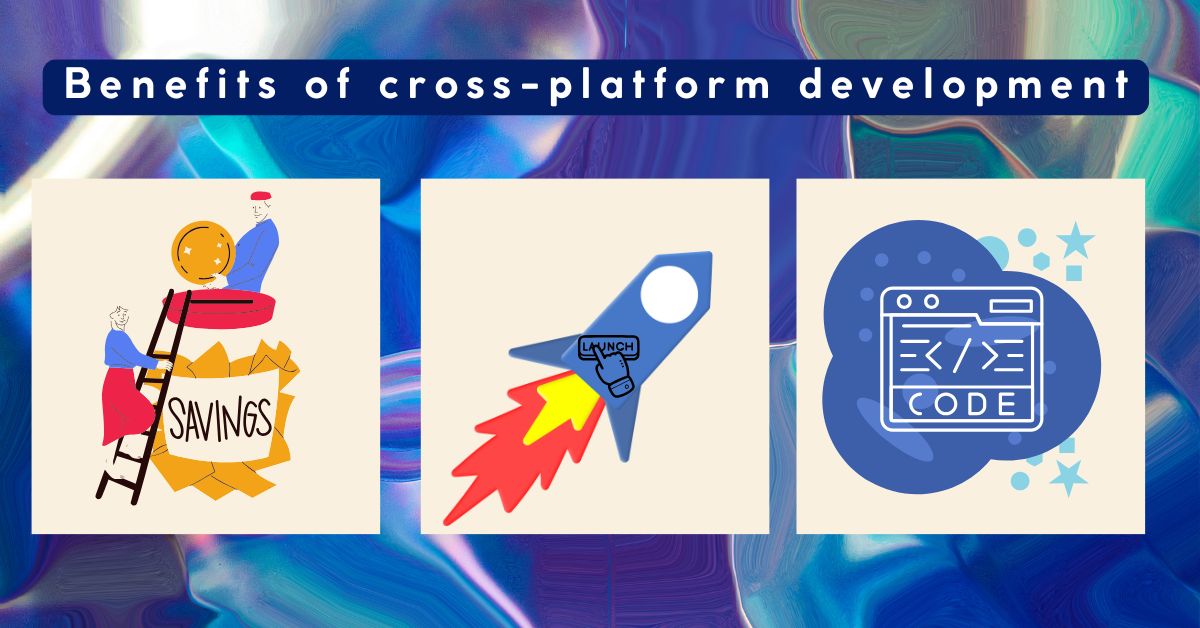
Cross-platform development helps companies reduce costs, launch faster, and reuse code across platforms. These benefits directly impact time-to-market, team structure, and long-term product scalability.
Teams build one shared codebase and deploy it across iOS and Android. This approach simplifies delivery, reduces duplication, and keeps product updates consistent.
Cost savings
Cross-platform development reduces both development and operational costs. A single team works on one codebase instead of maintaining two separate ones. This removes the need to hire and manage dedicated iOS and Android teams.
Infrastructure costs also decrease. Teams maintain one backend and one testing process. Updates and bug fixes apply to both platforms simultaneously, reducing long-term maintenance overhead.
Faster launch
Cross-platform development shortens time-to-market. Teams build features once and release them on multiple platforms without duplicating effort. This speeds up initial product launch and allows faster iteration after release.
Faster delivery helps startups validate ideas earlier. It also allows businesses to collect feedback from a wider audience and improve the product based on real usage data.
Code reuse
Cross-platform architecture enables high code reuse across platforms. Developers write shared logic once and use it across iOS and Android. This ensures consistency in features and reduces the risk of platform-specific bugs.
Code reuse also simplifies scaling. Teams can extend functionality without rebuilding core components. This supports gradual product growth and aligns with how digital products evolve over time.
Cross-Platform vs Native Development
The choice between native and cross-platform development depends on your product’s specific goals. Native provides the highest performance and access to all device features, making it ideal for applications that rely on advanced graphics or integrate complex hardware.
Conversely, the primary concern in cross-platform development is efficiency; therefore, the vast majority of business applications developed using this method can deliver sufficient performance at a lower cost and development time than native development. In the early stages, most startups prioritize efficiency over maximum performance, so an MVP or standard business application typically does not require many of the native capabilities.
The table below presents a concise and practical comparison of native vs. cross-platform app development services.
| Approach | Pros | Cons | Best for |
|---|---|---|---|
| Native | Maximum performance and speed Full access to device features (GPS, camera, sensors) Better UX for platform-specific interactions | Higher development cost (separate iOS and Android teams) Longer time-to-market More complex maintenance | High-performance apps Gaming and AR/VR Apps with heavy hardware integration |
| Cross-platform | Lower development cost due to shared codebase Faster launch across platforms Easier maintenance and updates | Slight performance limitations in complex scenarios Limited access to some low-level device features Possible UI compromises | MVPs and startups SaaS platforms E-commerce apps Standard business applications |
As a result, cross-platform development is well-suited to SaaS platforms and e-commerce solutions. Native development becomes more relevant when performance requirements increase.
When Cross-Platform Development Is the Best Choice (and When It’s Not)
Cross-platform development works best when speed and cost efficiency are priorities. It suits MVPs and products that do not rely heavily on device-specific features.
At the same time, it has limitations. Applications that require high-performance graphics, such as games, often depend on native development. The same applies to solutions with complex hardware integrations or advanced AR features.
Understanding these limits helps teams avoid performance issues and choose the right approach for their product.
Real-World Use Cases of Cross-Platform App Development
Cross-platform development can help businesses achieve their objectives, as demonstrated by real-life examples. For example, a fintech startup that created an MVP using Flutter, a cross-platform framework, for their first application was able to build their mobile app within a few months, analyze feedback from both Apple and Android devices, and use that information to improve their product before scaling.
In another instance, a company that sells products online expanded its business by creating its application with React Native after building its website with traditional web technologies. By using the same backend logic across both applications, they reduced development costs while still reaching mobile users quickly and improving conversion rates.
A SaaS company tested mobile demand with a cross-platform application. Instead of committing to full native development, the team validated the idea and scaled later based on user behavior. These examples highlight a clear pattern. Cross-platform development reduces risk and supports early-stage experimentation.
Future Trends in Cross-Platform Development
Cross-platform development continues to evolve as frameworks mature and business demands shift toward speed and efficiency. Several trends shape how companies adopt this approach.
Improved performance and near-native experience
Modern frameworks such as Flutter and React Native significantly reduce the performance gap with native apps. Optimizations in rendering engines and better access to native APIs allow cross-platform apps to handle more complex use cases. For most business applications, performance is no longer a limiting factor.
Growing adoption among startups and enterprises
Startups use cross-platform development to launch faster and validate ideas. At the same time, enterprises adopt it to reduce costs and unify development processes. This dual adoption increases ecosystem maturity, expands tooling, and improves long-term support.
Demand for faster and cost-efficient development
Market pressure continues to push companies toward faster product delivery. Investors expect quicker validation, while competition requires constant iteration. Cross-platform development aligns with these expectations by enabling faster releases, lower costs, and more flexible scaling. As a result, it becomes a standard choice for many new digital products.
Conclusion
Cross-platform app development services provide a practical way to launch products efficiently. They reduce development costs and support scalable growth.
For startups, this approach aligns with the need to move fast and validate ideas early. It allows teams to build, test, and improve without unnecessary complexity.
Choosing cross-platform development is not only a technical decision. It is a business strategy that helps companies enter the market faster and grow with confidence.