At a Glance
Racking design in a food distribution warehouse has to solve two problems at once: storage density and cold chain integrity. A layout that maximizes pallet positions but ignores temperature zoning or rack load ratings creates food safety risk and OSHA exposure. This matters most for warehouse managers and founders scaling a distribution or 3PL operation who need to plan for growth without rebuilding the facility every two years. Getting the rack type, aisle width, and temperature zoning right the first time solves most of the operational headaches that show up later.
Key Takeaways:
- Selective pallet racking works for high-turnover, single-SKU-per-pallet zones, while push-back and drive-in systems suit bulk cold storage with lower pick frequency
- Every steel storage rack installed in the US should meet ANSI MH16.1, the RMI-developed standard that OSHA references under its General Duty Clause
- Aisle width and forklift turning radius determine storage density more than shelf height in most retrofits
- Freezer zones need to hold 0°F and refrigerated zones 40°F or below, and rack material has to tolerate that temperature swing without warping
- Load capacity placards and documented rack inspections protect both employees and the business from liability if a rack fails
Food distributors work under tighter margins for error than most warehouse operators. A missed temperature reading or an overloaded rack doesn’t just cost inventory, it can trigger a health department violation or a workplace injury claim. Racking design in this environment isn’t a matter of fitting more pallets into a footprint. It requires balancing storage density against the structural and thermal demands of moving perishable products through a facility every day.
What Makes Food Distribution Racking Different
Standard warehouse racking gets selected mostly for load capacity and space efficiency. Food distribution adds temperature cycling, sanitation requirements, and faster turnover for perishable SKUs into that same decision. Steel components exposed to repeated freeze-thaw cycles corrode faster than the same rack in a dry goods warehouse, and any layout serving a cold zone needs enough clearance for insulated dock doors and strip curtains that a standard dry warehouse never has to plan around.
Choosing the Right Rack Type for Each Zone
Selective Pallet Racking for High-Turnover Zones
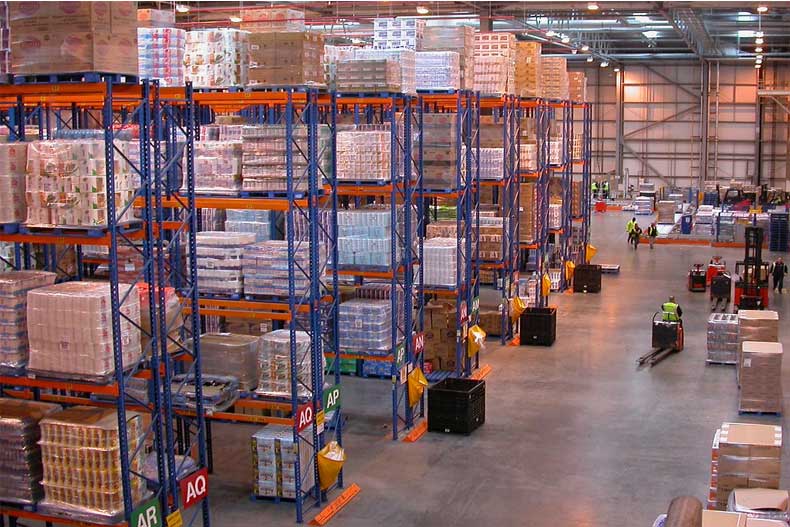
Selective pallet racking gives direct access to every pallet position, which makes it the right choice for fast-moving SKUs where product needs to be picked, rotated, and replaced constantly. It costs less per pallet position than deep-lane systems, and it supports the kind of first-in-first-out rotation that perishable inventory management depends on. The trade-off is lower storage density per square foot compared to bulk systems, since every position needs its own aisle access.
Push-Back and Drive-In Systems for Bulk Cold Storage
Push-back and drive-in racking sacrifice individual pallet access in exchange for significantly higher density, which makes sense for slower-turning bulk cold storage where a handful of SKUs occupy most of the freezer footprint. These systems load from one end and store multiple pallets deep, which reduces the number of aisles needed and keeps compressor load lower by minimizing open floor space in refrigerated zones.
Optimizing Layout for Storage Density
Aisle Width and Forklift Clearance
Aisle width is often the single biggest lever for storage density in an existing facility. Narrower aisles paired with reach trucks or narrow-aisle forklifts free up floor space for additional rack runs, but the forklift fleet has to match the aisle width before any redesign happens. Retrofitting a warehouse for narrow-aisle equipment without checking existing dock and staging clearances tends to create bottlenecks at the exact points where product moves fastest.
For teams evaluating a broader redesign, the same principles covered in how to make a warehouse more efficient apply directly to aisle planning and slotting strategy.
Vertical Storage Expansion
Adding height to a racking system increases storage density without expanding the building footprint, provided the ceiling clearance, sprinkler placement, and rack load ratings all support it. Vertical expansion works well for slower-moving SKUs stored higher up, while fast-moving product stays at ground level for easier picking. Any vertical addition should go through a licensed rack engineer, since adding height changes the load calculations for the entire structure.
Designing for Cold Chain Compliance
Freezer and Cooler Zone Placement
The FDA requires refrigerated storage at or below 40°F and frozen storage at 0°F or lower to keep perishable inventory out of the bacterial danger zone. Rack placement in these zones needs to account for airflow, since blocked vents or overpacked shelves create warm spots that compromise temperature consistency even when the unit itself is reading correctly. Positioning a commercial freezer near the receiving dock cuts the distance frozen product travels before it’s stored, which reduces the time inventory spends in transitional temperatures during unloading.
Meeting Load and Safety Standards
Every steel pallet rack installed in a US food distribution warehouse should meet ANSI MH16.1, the design and testing standard developed by the Rack Manufacturers Institute. OSHA doesn’t publish its own detailed rack engineering rules, but inspectors reference ANSI MH16.1 under the General Duty Clause when evaluating whether a warehouse maintains a recognized safe standard. Every rack bay needs a visible load capacity placard, and a documented inspection schedule, typically annual professional assessments backed by informal monthly walk-throughs, catches damaged columns and leaning frames before they turn into a collapse.
Facility teams planning a broader upgrade alongside the racking redesign can find additional groundwork in practical facility upgrades for small businesses, which covers related infrastructure decisions that often get bundled into the same project.
Common Mistakes in Food Warehouse Racking Design
- Sizing aisles for current forklifts without planning for narrower equipment that could free up storage space later
- Placing high-turnover SKUs in deep-lane storage, which slows picking and increases labor cost per order
- Underestimating the load rating needed for a vertical expansion and skipping engineering review
- Locating freezer zones far from receiving docks, which extends the time product spends outside safe temperature ranges
- Treating rack inspection as a one-time installation step instead of an ongoing safety program
FAQs
What’s the best racking system for a food distribution warehouse?
It depends on turnover rate. Selective pallet racking suits fast-moving SKUs that need constant access, while push-back or drive-in racking works better for bulk cold storage with slower turnover and fewer distinct SKUs.
How cold does a warehouse freezer zone need to be?
The FDA requires frozen storage at 0°F or lower and refrigerated storage at 40°F or below. Rack placement in these zones should avoid blocking airflow, since blocked vents create warm spots even when the unit’s overall temperature reads correctly.
Do warehouse racks need to meet a specific safety standard?
Yes. ANSI MH16.1, developed by the Rack Manufacturers Institute, sets the design and load testing requirements for steel storage racks in the US. OSHA references this standard when evaluating warehouse safety under its General Duty Clause.
How often should warehouse racks be inspected?
Best practice includes daily informal visual checks by staff, monthly documented walk-throughs by a safety coordinator, and at least one annual assessment by a qualified rack engineer or certified inspector.
Can vertical storage expansion work in an existing warehouse?
Often, yes, provided ceiling clearance, sprinkler placement, and the rack’s load rating support the added height. Any vertical expansion should be reviewed by a licensed rack engineer before installation, since it changes the load calculations for the entire structure.
Final Thoughts
An efficient racking system in a food distribution warehouse comes down to matching rack type to product turnover, respecting temperature zoning, and meeting the structural standards that keep both inventory and employees safe. Storage density matters, but not at the cost of cold chain integrity or rack load compliance. Warehouses that get this balance right the first time avoid the retrofit costs and safety citations that come from chasing density alone.